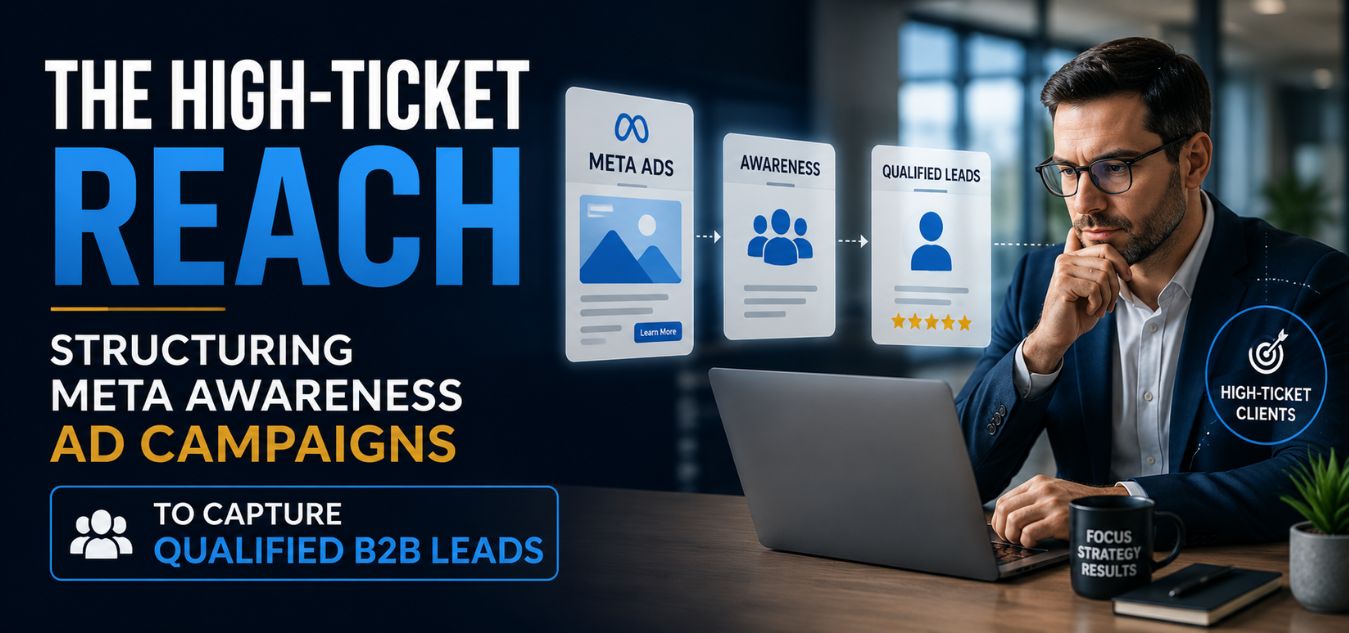
The High-Ticket Reach: Structuring Meta Awareness Ad Campaigns to Capture Qualified B2B Leads
The Great B2B Meta Misconception
There is a persistent myth in the B2B marketing world: “Enterprise decision-makers do not use Facebook or Instagram for business.” This assumption causes agencies to pour their entire budget into LinkedIn.
Let’s be completely honest. While LinkedIn is a powerful platform, its Cost Per Mille (CPM) and Cost Per Click (CPC) are notoriously astronomical.
Meanwhile, the CEOs, CTOs, and procurement managers you are trying to reach are absolutely scrolling through Instagram on their lunch breaks. They are human beings, not just job titles.
💡 Executive Insight: The Multi-Platform Reality A $50,000 enterprise software contract is rarely won on a single platform. High-ticket B2B sales require omnipresence. Meta (Facebook and Instagram) allows you to build massive brand awareness and retarget high-value prospects at a fraction of LinkedIn’s cost.
Today, we are unpacking the exact architecture of a high-ticket B2B Meta ad campaign. We will show you how to capture qualified leads without setting your daily budget on fire.
By the end of this guide, you will understand how to use Meta’s algorithm to your advantage, turning casual scrolling into corporate revenue.
Why Meta is Your Secret B2B Weapon
If you treat Meta like a B2C e-commerce platform, you will fail. You cannot run an aggressive “Buy Now” ad for a $10,000-a-month enterprise retainer and expect a CTO to instantly swipe their corporate card.

B2B buyers require deep trust, education, and undeniable social proof before they ever fill out a lead form. Meta’s primary superpower in the enterprise space is not instant conversion; it is frictionless, highly targeted distribution at scale.
To understand why shifting your B2B budget is a competitive necessity, look at these rapid-fire industry benchmarks:
- The Engagement Reality: According to Gartner research, a massive 70% of B2B buyers actively utilize Facebook for research and informed purchasing decisions.
- The Attention Advantage: B2B decision-makers actually spend 74% more time on Facebook daily compared to average users, giving you an enormous window for brand exposure.
- The Conversion Metric: The median Click-Through Rate (CTR) for B2B lead generation campaigns on Meta sits at a highly profitable 2.59%, proving executives absolutely do click on relevant ads.
Here is exactly how Meta’s operational micro-data compares to LinkedIn when structuring a high-ticket B2B funnel:
| Campaign Metric | LinkedIn Ads (The Premium Trap) | Meta Ads (The Efficiency Engine) |
| Cost Per 1,000 Impressions (CPM) | Extremely High ($30 – $100+) | Highly Cost-Effective ($5 – $15) |
| The User’s Mindset | Actively networking, formal, and heavily guarding their inbox from sales pitches. | Relaxed, visually driven, and highly open to engaging storytelling. |
| Best Funnel Stage | Bottom-of-Funnel (Direct Lead Generation and outbound messaging). | Top-of-Funnel (Awareness) & Mid-Funnel (High-Intent Video Retargeting). |
| The Creative Demand | Text-heavy, formal corporate whitepapers and long-form PDFs. | High-fidelity visuals, 2D motion graphics, and humanized video. |
Your goal on Meta is not to force a boardroom marriage on the very first date. Your goal is to buy cheap, highly targeted attention and seamlessly filter that attention into your sales pipeline.
The “Burn Rate” Trap: What Not to Do
Before we build a highly profitable B2B campaign, we must first stop the financial bleeding. Most enterprise companies completely abandon Meta advertising after a single week because they structure their ads poorly, draining their budget with zero return.
Running a high-ticket B2B ad without a multi-step architecture is like proposing marriage to a stranger on the street, it instantly destroys trust and guarantees a rejection.
If your current campaigns are generating zero enterprise ROI, you are almost certainly falling into one of these three massive, budget-burning traps:
- The Broad Targeting Trap
- The Mistake: Leaving your audience parameters wide open and hoping the Meta algorithm figures it out for you.
- The Reality: Without strict professional guardrails, Meta will happily spend your entire enterprise ad budget showing your complex SaaS product to teenagers and retirees.
- The “Lead Form” Trap
- The Mistake: Demanding a corporate email and phone number on the very first ad interaction.
- The Reality: High-ticket buyers fiercely protect their time and data; they will never hand over their contact information to a vendor they just discovered five seconds ago.
- The “Stock Photo” Trap
- The Mistake: Relying on generic, forgettable images of people in suits shaking hands across a boardroom table.
- The Reality: In a highly stimulating visual feed, boring stock photos act as digital camouflage, ensuring your ad fails to stop the scroll and is completely ignored by decision-makers.
To succeed on this platform, you must fundamentally change your approach. You must engineer a multi-step digital architecture that patiently earns executive trust before it ever asks for a calendar booking.
Step 1: The Top-of-Funnel (Awareness) Engine

The absolute foundation of the High-Ticket Reach strategy begins with the “Video View” or “Brand Awareness” objective. At this stage, you are absolutely not asking anyone to buy anything. Your singular goal is to distribute high-value, educational content to a specific audience and measure exactly who pays attention.
The Boardroom Disconnect
CEO: “We spent $2,000 on Meta ads this week and got zero booked demos. Turn the campaign off.”
CMO: “Because we asked for a $50,000 commitment before we even introduced ourselves. We have to earn their attention first.”
To avoid that exact conversation, you must reframe how you view top-of-funnel advertising. You are not hunting for instant sales; you are building an “invisible list” of qualified prospects.
Keep these foundational principles in mind when launching your awareness engine:
- Stop Selling, Start Educating: High-ticket B2B buyers require deep trust. Deliver actionable insights that solve an immediate problem for them for free.
- Train the Algorithm: By running awareness ads, you are actively giving the Meta algorithm the data it needs to find the exact type of professional who cares about your complex service.
To ensure your campaign is structurally sound, let’s contrast the wrong approach with the right approach:
| Campaign Mindset | The Amateur “Burn Rate” Approach | The High-Ticket Strategy |
| The Primary Goal | Forcing a cold prospect to book a demo immediately. | Capturing targeted attention and educating the buyer. |
| The Optimization | Running expensive “Lead Generation” objectives. | Running highly efficient “Video View” objectives. |
Here is the exact tactical breakdown of how to build your Awareness Architecture:
| Campaign Pillar | The Tactical Execution | The Strategic Purpose |
| The Targeting | Use detailed targeting for specific job titles (e.g., “CTO”, “IT Director”) or niche interests (e.g., “Cloud Computing”). | Ensures your budget is only spent on the specific decision-makers who have the authority to sign the contract. |
| The Budget | Allocate exactly 30% of your total ad budget here. Keep the daily spend low but completely consistent. | You are buying cheap, long-term data and audience insights, rather than expensive, immediate clicks. |
| The Asset | Run a 60-second educational video or a bespoke animated infographic that solves a specific, painful problem. | Instantly proves your operational expertise, establishing your brand as a helpful authority in the space. |
| The CTA | Use soft calls-to-action like “Learn More” or “Read the Case Study.” Never use “Book a Demo.” | Lowers the barrier to entry, making the executive feel safe clicking without the threat of an immediate sales pitch. |
Creative is the New Targeting
Since the iOS 14 privacy updates, hyper-granular targeting on Meta is much harder. You cannot rely on the algorithm alone to find your perfect B2B buyer.

Today, your ad creative is your targeting. If your visual asset calls out a specific enterprise pain point, only qualified buyers will stop to look at it.
This is why generic, amateur design will destroy your ad performance.
How to engineer scroll-stopping B2B creative:
- The Hook: The first three seconds must visually and textually address the buyer. Use bold, high-contrast text overlays like: “Is your legacy CRM costing you enterprise deals?”
- 2D Motion Graphics: Complex data is boring. We use abstract 2D motion graphics to visually explain complex software integrations or logistics supply chains in seconds.
- High-Fidelity Polish: Enterprise buyers judge your operational competence by your visual maturity. If your ad looks cheap, they will assume your $50,000 product is also cheap.
Why Meta’s Algorithm Rewards Strong Creative
Meta’s machine learning system studies how users interact with your ads. It watches who pauses, clicks, watches videos longer, saves posts, or visits landing pages. Over time, it uses those engagement patterns to identify similar high-intent users.
If your creative speaks directly to the right audience, Meta learns faster and distributes the campaign more efficiently.
For example:
- A generic ad saying “We Help Businesses Grow” attracts broad, low-quality engagement.
- An ad saying “How SaaS Companies Reduce Enterprise Sales Cycles by 40%” naturally filters for a more specific audience.
The second message instantly qualifies the viewer before they even click.
That is the real power of creative-led targeting.
Step 2: The Invisible Retargeting Engine
This is where the magic happens and where your ROI is generated. Remember that 60-second educational video you ran in the Awareness phase? Meta tracked everyone who watched it.
You can now create a “Custom Audience” of people who watched at least 50% of that specific video.

Think about the psychology: A CTO just spent 30 seconds watching a video about API security. They are highly qualified, and you didn’t even have to ask for their email address.
Here is how you structure the Consideration/Conversion phase:
| Funnel Element | The Execution Strategy | The Psychological Goal |
|---|---|---|
| The Audience | Retarget only users who watched 50%+ of your top-of-funnel video or engaged with your Instagram page. | You are only spending money on executives who have already demonstrated high-intent interest. |
| The Creative Asset | A deep-dive case study, a client testimonial video, or a specific ROI breakdown of your service. | Prove your absolute authority and show them that their peers are already succeeding with your product. |
| The Landing Page | Send them to a highly optimized, lightning-fast landing page dedicated strictly to this specific ad topic. | Remove all distractions. Provide immense value, and clearly outline the next steps to book a strategy call. |
By separating your funnel into Awareness and Retargeting, you protect your daily budget. You stop wasting money asking cold audiences to marry you, and start investing heavily in warm prospects.
Case Study Snapshots: B2B Meta Success
Theoretical ad strategies only matter if they drive actual pipeline revenue. Transitioning from a “direct response” mindset to an “awareness-first” mindset is often difficult for founders.
Here is how structuring Meta campaigns for cognitive ease and high-ticket value solves massive acquisition bottlenecks:
Case Study Snapshot: The Custom Software Agency
- The Bottleneck: An agency was burning $100 a day on Meta lead-gen forms asking for app development contracts. They generated zero qualified leads in a month.
- The Campaign Fix: We switched to a Top-of-Funnel awareness video explaining the “Hidden Costs of Offshore Development.” We then retargeted the video viewers with a high-end portfolio carousel.
- The ROI: The cost per qualified lead dropped by 80%. Because the prospects were educated before they clicked, the sales team closed two enterprise contracts within 45 days.
Case Study Snapshot: The EdTech SaaS Platform
- The Bottleneck: An educational software company was struggling to reach university administrators. Their LinkedIn ads were too expensive to sustain year-round.
- The Campaign Fix: We deployed highly branded, bespoke infographics on Facebook and Instagram targeting higher-education job titles. We used localized targeting for key university cities.
- The ROI: The visual data instantly stopped the scroll. They captured high-ticket administrator leads at a fraction of the cost of their previous LinkedIn campaigns, scaling their localized awareness massively.
Measuring What Actually Drives Revenue

When you run an awareness campaign, you cannot judge its success purely by how many “leads” you got on day one. That is the wrong metric for top-of-funnel advertising.
If you panic and turn off an awareness ad because it hasn’t generated a $50k contract in 48 hours, you will never build a sustainable pipeline.
You must educate your C-suite and your marketing team to look at the leading indicators of success.
Track these critical metrics to ensure your Meta budget is safe:
- Cost Per ThruPlay: How much does it cost you to get a user to watch at least 15 seconds of your video? If this is cheap, your creative is highly effective.
- Outbound Click-Through Rate (CTR): Are people actually leaving the Meta platform to read your case studies? A high outbound CTR means your messaging is resonating perfectly.
- Frequency: How many times is the same person seeing your ad? If your frequency creeps above 3.0 on a retargeting ad, your audience has ad fatigue. Swap the creative immediately to avoid burning cash.
Track the Entire Buyer Journey
One of the biggest challenges in B2B advertising is attribution. High-ticket purchases rarely happen after a single ad click. Buyers often interact with multiple touchpoints before making a decision.
A prospect may:
- Watch a Meta video ad
- Visit your website days later
- Read case studies
- Attend a webinar
- Book a discovery call weeks later
- Convert months afterward
If you only measure last-click conversions, you miss the true impact of your awareness campaigns.
Build a Multi-Touch Attribution Model
To understand campaign performance accurately:
- Use CRM integration with Meta Ads
- Track UTM parameters consistently
- Monitor assisted conversions
- Connect ad engagement data with sales outcomes
- Analyze customer journeys across channels
This approach helps reveal which campaigns are influencing high-value prospects early in the buying process.
Final Thoughts: The Long-Term Pipeline
Winning in the high-ticket B2B space is not about finding a secret algorithm hack. It is about understanding human psychology and respecting the buyer’s journey.
Your enterprise clients are active on Meta right now. They are scrolling past generic, boring corporate ads every single day.
If you can interrupt their feed with stunning, custom visual design, educate them with high-value content, and gently retarget them with undeniable proof of your expertise, you will win their business.
Stop burning your daily budget on aggressive, cold lead-gen forms. Start building a sophisticated, multi-step awareness architecture that quietly fills your pipeline with highly qualified prospects.
Frequently Asked Questions (FAQs)
1. Should we run Facebook Lead Forms or send traffic to our website?
For high-ticket B2B sales, always send traffic to your own website or a dedicated landing page. While Facebook native Lead Forms are cheaper and generate a higher volume of leads, the quality is notoriously low (lots of accidental clicks and personal email addresses). Sending a user to your website forces them to read your content, proving higher intent and allowing you to capture their corporate data more effectively.
2. How much daily budget do we need to test a B2B Meta campaign?
You do not need massive corporate budgets to start. We recommend a minimum of $30 to $50 per day for the initial testing phase. Allocate the majority of this to your Top-of-Funnel video awareness campaign to feed the algorithm data. Once you build a custom audience of video viewers, you can launch a retargeting campaign for as little as $5 to $10 a day, because the audience size is highly concentrated.
3. Does the iOS 14 privacy update mean Meta can’t track B2B buyers anymore?
The iOS 14 update severely impacted Meta’s ability to track what users do after they leave the Facebook or Instagram app. However, Meta can still track everything a user does inside the app with 100% accuracy. This is why our strategy focuses heavily on native Video Views and Instagram page engagement. By retargeting based on in-app behavior, you completely bypass the iOS 14 tracking limitations.
About the Author