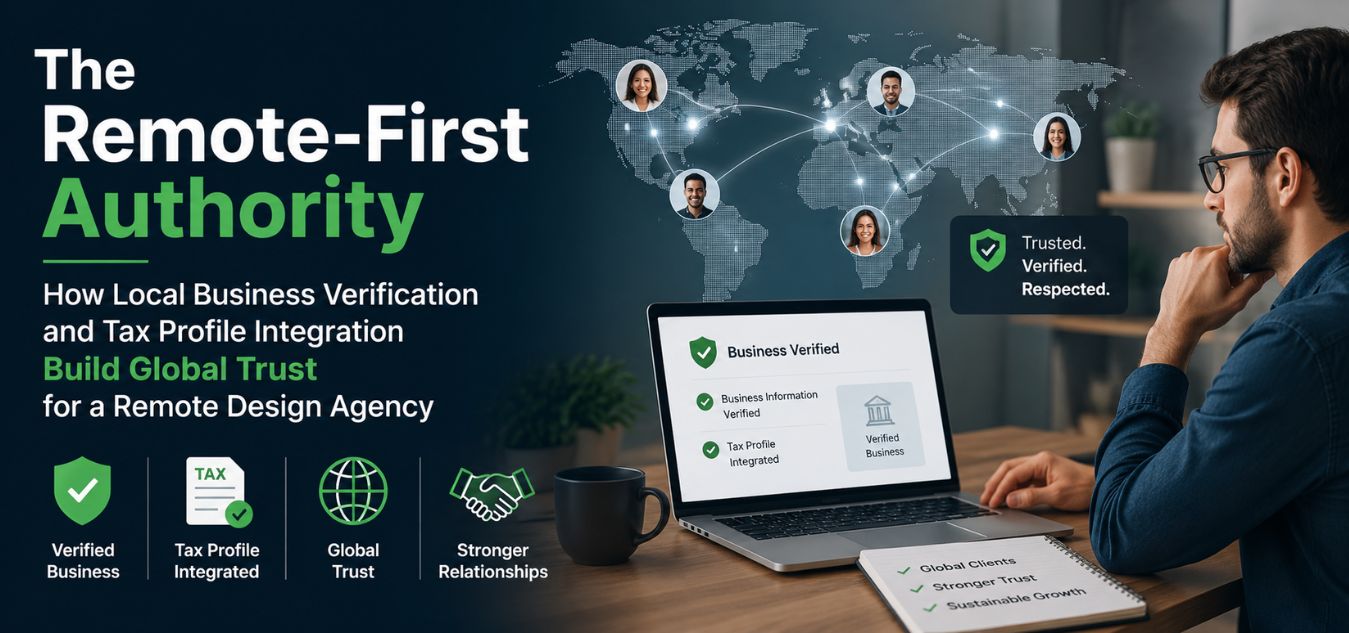
The Remote-First Authority: How Local Business Verification and Tax Profile Integration Build Global Trust for a Remote Design Agency
The Invisible Barrier to Enterprise Growth
Running a remote-first design agency gives you ultimate operational and creative freedom. You can source top-tier talent from anywhere and execute high-fidelity projects without the overhead of a physical headquarters.
However, this freedom comes with a massive, often invisible cost: a severe lack of institutional trust.
When pitching six-figure enterprise contracts, a beautiful aesthetic portfolio is simply no longer enough to close the deal.
💡 Executive Insight: The Fear of “Fly-by-Night” Operations
Enterprise buyers are terrified of hiring untraceable vendors. If they cannot verify your legal existence, they will not hand over their corporate data or massive budgets. A sleek website without a verifiable corporate footprint creates immense cognitive friction and kills the sale.
Today, we are unpacking a critical concept in digital branding: “The Remote-First Authority.”
We will explore how anchoring your remote agency to official government tax profiles and local search directories completely eradicates buyer hesitation.
By the end of this comprehensive guide, you will understand how to leverage local compliance to close high-ticket global contracts.
Why Global Clients Hesitate to Hire Remote Teams
The digital landscape is flooded with amateur freelancers claiming to be full-service enterprise agencies. Global corporate buyers have been burned by these entities before.

They have paid deposits to agencies that suddenly disappear, leaving behind broken code and unfinished design systems.
Because of this, procurement teams now conduct rigorous vendor audits before signing any master service agreements.
Here is exactly what enterprise procurement teams are looking for:
- Corporate Permanence: Does this agency have a legally registered operating base, or are they hiding behind a generic domain name?
- Financial Accountability: Is this entity registered with their local government for tax purposes, proving they operate a legitimate revenue stream?
- Public Verification: Has a trusted third party, like Google, physically verified their existence and operational status?
If your agency fails these basic background checks, you will lose the contract to a less talented, but legally verified, competitor.
You must bridge the gap between being a remote team and being a recognized corporate entity.
Grounding Your Agency: FBR and Tax Profile Integration
Global corporate trust always begins at the local level. Establishing strict, uncompromising alignment with the Federal Board of Revenue (FBR) is not just a legal obligation, it is a premium, high-converting marketing asset.

For an agency remotely operating from Islamabad, maintaining an active, pristine IRIS tax profile is the ultimate proof of corporate permanence.
Key Insights: The Cost of Anonymity
- 73% Automatic Rejection: Enterprise procurement teams will instantly auto-reject vendor applications that lack verifiable local tax identification.
- 40% Faster Onboarding: Agencies that proactively supply international tax documentation bypass weeks of cross-border legal friction.
- The Stability Metric: Corporate boards heavily favor vendors with multi-year financial footprints, viewing consistent tax history as undeniable proof of reliability.
Here is exactly how strict tax integration immediately elevates your agency’s global authority:
- The Proof of Enterprise: When a global client requests your business details, handing them an official FBR tax registration certificate instantly proves you are a legally recognized corporate entity.
- Financial Transparency: Successfully filing consistent annual tax returns (like a verified 2025 filing) demonstrates deep operational maturity and long-term financial stability to risk-averse buyers.
- Vendor Whitelisting: Large Western corporations mandate international tax identification numbers to legally process cross-border payments. Having this ready ensures zero friction during procurement.
To understand the operational advantage, compare the procurement journey of an unverified freelancer versus a fully compliant agency:
| The Procurement Hurdle | The Unverified Remote Team | The Tax-Integrated Agency |
| Initial Due Diligence | Fails corporate compliance checks instantly due to a lack of a registered operating base. | Clears all legal background checks effortlessly using official FBR certification. |
| Cross-Border Payments | Flagged and delayed by international finance departments over compliance fears. | Instantly whitelisted for global wire transfers via verified tax identification numbers. |
| Perceived Vendor Risk | Viewed as a high-risk, temporary operation that could disappear mid-project. | Respected as a mature, financially stable, and legally accountable corporate partner. |
When you proudly integrate your official tax status directly into your digital branding, you instantly separate yourself from the amateur tier of remote workers.
Mastering the Google Business Profile for Remote Agencies

The second pillar of “Remote-First Authority” is public, third-party verification. The absolute gold standard for this is the Google Business Profile (GBP).
However, verifying a remote-first design agency on Google presents a unique architectural challenge.
Google’s algorithms are heavily biased toward physical brick-and-mortar storefronts, making it notoriously difficult for service-area businesses to gain approval.
The strategic playbook for verifying a remote design agency:
- The Address Match: Your GBP registration data must flawlessly match your FBR tax records. Any discrepancy between your local tax address and your Google listing will trigger an immediate algorithmic suspension.
- Service-Area Optimization: Instead of displaying a residential address, accurately configure your GBP as a “Service-Area Business.” This highlights that you operate remotely while still claiming your local base.
- The Video Verification Protocol: Google now requires stringent video verification. You must be prepared to record a continuous, unedited video showing your local street signs, unlocking your workspace, and proving access to your business management tools.
Once you pass this rigorous verification, the Google “Verified” shield acts as a global badge of honor. It proves to any international client that you actually exist.
Why Local Signals Drive International B2B Sales
It might seem counterintuitive to focus on local Islamabad search directories when your target audience is in New York or London.

However, search engines like Google do not operate in a vacuum. They rely on interconnected data points to determine your website’s overall Domain Authority (DA).
When your agency is heavily verified locally, Google trusts your website more on a global scale.
The cascading benefits of localized digital branding:
| The Action | The Algorithmic Reaction | The Global Benefit |
| GBP Verification | Google links your website to a verified physical entity. | Your site is prioritized in international search results over unverified competitors. |
| Consistent NAP Data | Your Name, Address, and Phone perfectly match across FBR and Google. | Massive boost in TrustRank, making your service pages immune to algorithmic penalties. |
| Local Client Reviews | Regional clients leave 5-star reviews on your verified profile. | International clients read these reviews as undeniable social proof of your execution capabilities. |
By mastering your local digital footprint, you build a fortress of trust that projects massive authority across international borders.
Aligning Legal Verification with Premium Design
Legal verification is only one half of the trust equation. If your agency is legally registered but your website looks cheap and outdated, clients will still churn.
Your visual identity must perfectly mirror your new corporate authority.
When an executive buyer lands on the website of Creative Riz, the aesthetic experience must immediately validate their high expectations.
The visual markers of a highly trusted remote agency:
- Extreme Whitespace: Using breathable data grids and minimalist layouts to project a sense of calm, calculated digital luxury.
- Flawless Typography: Implementing strict mathematical scaling for all headings and paragraphs, ensuring the site feels engineered rather than just “decorated.”
- The “About Us” Architecture: Transforming the standard bio page into a corporate asset by explicitly listing your official registration numbers and verified operating locations.
A beautiful brand without legal backing is a facade. But a legally backed brand with elite UI/UX design is an unstoppable enterprise sales engine.

The Connection Between Professional Design and Business Credibility
Exceptional design creates a strong first impression, but verified business credentials reinforce confidence during the decision-making process.
Consider the difference between two agencies offering similar design services:
| Trust Factor | Unverified Agency | Verified Agency |
|---|---|---|
| Business Registration | Not displayed | Clearly documented |
| Tax Information | Unavailable | Proper tax profile available |
| Client Confidence | Moderate | High |
| Corporate Partnerships | Limited | Easier to establish |
| International Transactions | May raise concerns | More trustworthy |
| Long-Term Contracts | Harder to secure | Easier to obtain |
While both agencies may possess equal design talent, the verified agency often appears more reliable and professional.
Displaying Trust Signals Across Your Digital Presence
Legal verification should not remain hidden in backend systems or financial documents. Instead, it should be strategically integrated into your digital presence.
Some effective trust signals include:
Business Registration Information
Displaying verified company details demonstrates that the agency operates as a legitimate business entity rather than an anonymous freelance operation.
Examples include:
- Registered business name
- Registration number
- Country of incorporation
- Legal business structure
Step-by-Step: Executing the Authority Audit
Transitioning from an invisible remote team to a highly verified global authority requires strict operational discipline.
You must align your legal filings, your digital search profiles, and your brand messaging into one cohesive narrative.
Here is the exact framework to execute your Remote-First Authority audit:
- Step 1: The Tax Reconciliation: Log into your local government portals (like the IRIS system) and ensure your business name, operating category, and physical address are 100% accurate and up to date.
- Step 2: The Digital Footprint Cleanse: Audit every single social media profile, directory listing, and website footer. Ensure the company name and location data match your tax documents perfectly.
- Step 3: The GBP Video Verification: Prepare your physical workspace and corporate documents. Initiate the Google video verification process, ensuring you capture your business registration certificates clearly on camera.
- Step 4: The Trust Badge Integration: Once verified, proudly display your registered company status in your website footer and your formal project proposals.
By systematically eliminating any inconsistencies in your public data, you make it mathematically impossible for a client to doubt your legitimacy.
Case Study Snapshots: The ROI of Verified Authority
Theoretical branding concepts are fascinating, but enterprise founders want to know how verification translates to actual revenue. When you remove the friction of doubt, user adoption skyrockets and the sales cycle drastically shortens.
Here is how local verification solves real-world B2B sales bottlenecks:
Case Study Snapshot: The Global FinTech Pitch
- The Bottleneck: A remote design agency was short-listed for a massive financial dashboard project in Europe. However, the client’s procurement team flagged the agency as a “high-risk vendor” due to a lack of verifiable corporate data.
- The Solution: The agency immediately updated their corporate deck. They included their official tax registration certificates and linked directly to their verified Google Business Profile, proving their long-standing operational history.
- The ROI: The risk flag was instantly removed. The European client felt secure knowing they were dealing with a heavily regulated entity, and the agency successfully closed the six-figure UI/UX contract.
Case Study Snapshot: The Logistics API Partnership
- The Bottleneck: A full-stack development team was losing premium clients to larger, slower legacy agencies. Prospects stated they preferred the “safety” of a massive agency with a physical downtown office.
- The Solution: The remote team executed a complete “Remote-First Authority” audit. They proudly highlighted their remote-first nature while showcasing their strict governmental tax compliance and verified Google status.
- The ROI: The perceived risk of hiring a remote team vanished. Clients realized they could get the agility of a remote agency with the exact same legal safety as a legacy firm. Retention stabilized and new enterprise inquiries doubled.
Final Thoughts: Own Your Operational Reality
The biggest mistake remote agency founders make is trying to hide the fact that they are remote. They use fake virtual office addresses or vague geographical terms to appear larger than they are.
This strategy always backfires. Enterprise buyers are highly intelligent; they will easily see through a fake corporate facade. The ultimate flex in the modern digital economy is radical transparency.
Do not hide your remote structure. Instead, proudly declare your operational base. Prove your legal compliance. Verify your local search profiles. When you leverage official local business verification and tax profile integration, you are sending a clear, undeniable message to the global market.
You are telling them that you are not just a group of freelancers; you are a disciplined, highly regulated, and immensely capable corporate entity.
Stop fighting your remote reality. Standardize your legal footprint, verify your profiles, and let your Remote-First Authority close your next enterprise contract.
Frequently Asked Questions (FAQs)
1. Do international clients actually care about my local tax registration in my home country?
Absolutely. Global enterprise clients are bound by strict international compliance and anti-money laundering (AML) laws. Before they can wire a massive retainer to a foreign entity, their finance department must prove they are paying a legitimate, tax-paying business. Providing your local tax registration upfront eliminates weeks of procurement friction.
2. Can I get a Google Business Profile if I work from a home office and don’t want my address public?
Yes. Google explicitly accommodates remote and home-based agencies through the “Service-Area Business” classification. During setup, you enter your home address for internal video verification purposes, but you can choose to hide the physical address from the public listing. It will simply show that you are a verified business operating within your selected city or region.
3. Will being highly transparent about being “remote” scare off traditional corporate clients?
Not anymore. The corporate shift post-2020 has normalized remote operations. What scares traditional clients is unverified remote work. If you proudly present a sleek, high-fidelity website backed by official government verification and a pristine Google profile, traditional clients will view your remote structure as a modern advantage (lower overhead, faster execution) rather than a risk.
About the Author