
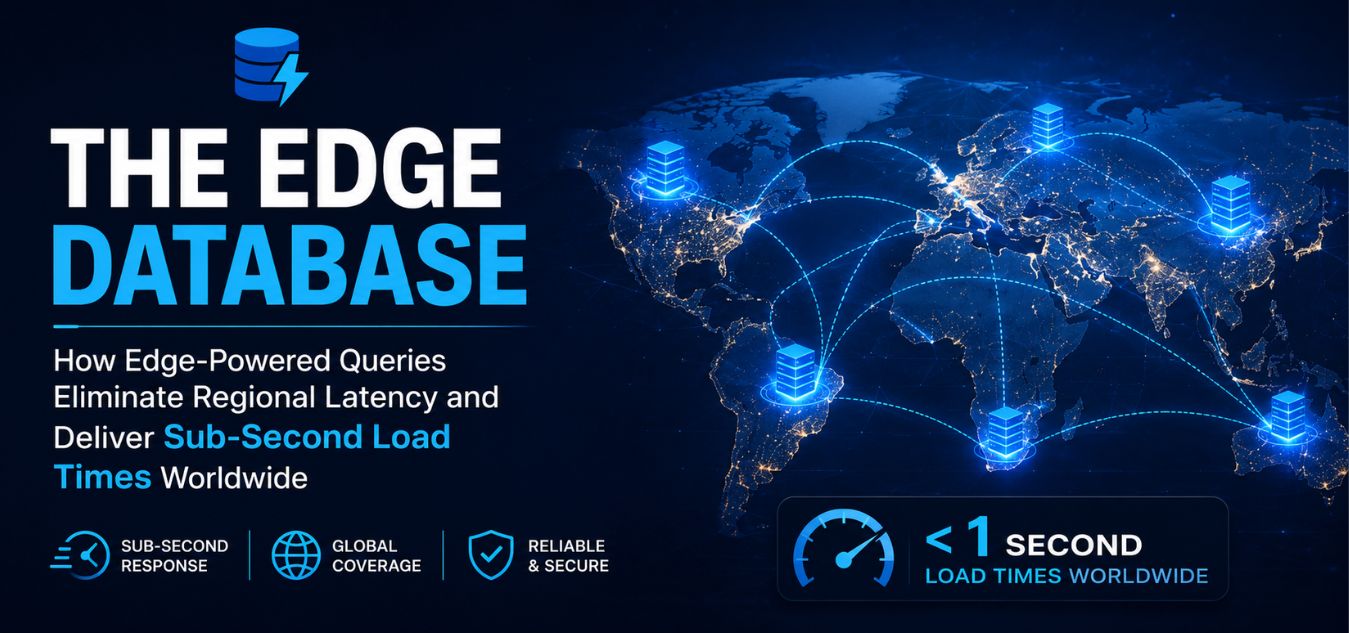
The Edge Database: How Edge-Powered Queries Eliminate Regional Latency and Deliver Sub-Second Load Times Worldwide
The Invisible Geography Penalty
You have invested thousands of dollars into a premium digital platform. Your UI/UX design is flawless, and your frontend framework is highly optimized.
However, when an enterprise client in London tries to load a dashboard hosted in New York, they are hit with a frustrating loading spinner.
This is the “Geography Penalty.” It occurs when your beautiful frontend has to wait for data traveling across the globe.
💡 Executive Insight: The Latency Churn
High-ticket enterprise buyers expect software to feel like a native desktop application. If your data takes longer than a single second to load, cognitive friction spikes. Buyers will not complain; they will simply churn and move to a faster competitor.
Today, we are unpacking a revolutionary concept in operational tech: The Edge Database.
We will explore how migrating your heavy backend queries away from a centralized server completely eliminates global latency.
By the end of this architectural guide, you will understand how to secure sub-second load times and protect your enterprise revenue.
Why Traditional Centralized Databases Fail Global Markets
For decades, the gold standard of software engineering was renting a massive, centralized server in a single location like US-East. But data cannot break the laws of physics.
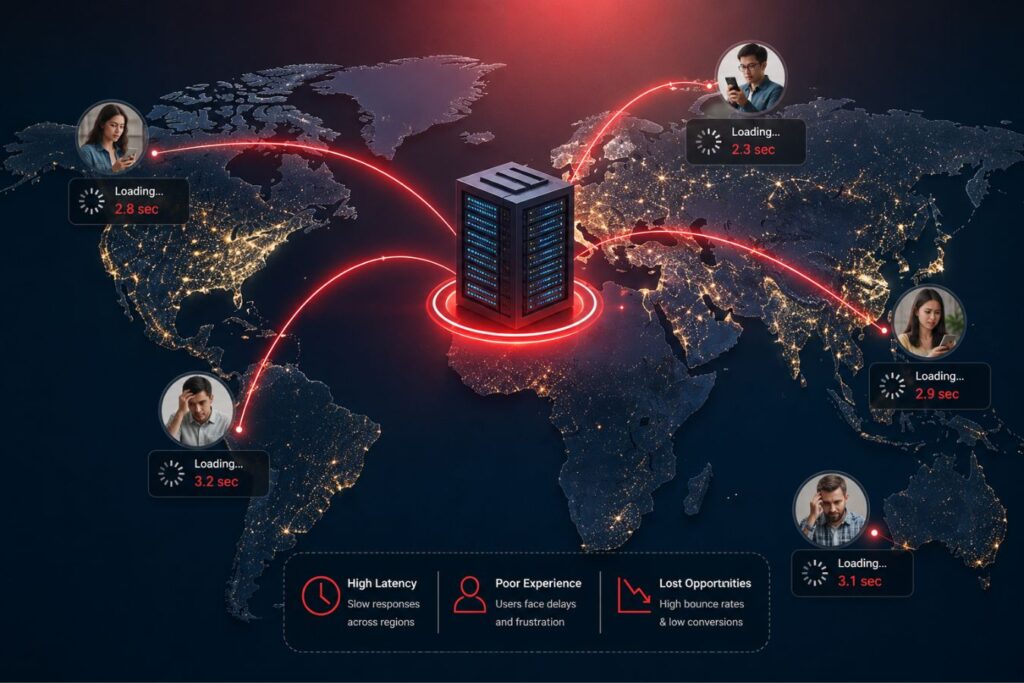
When every user from Tokyo to Berlin is forced to route their traffic back to one physical location, you are actively punishing your international clients with sluggish load times.
Challenging the “Bigger Server” Myth
- Conventional Advice: “If your application is running slow, just upgrade your cloud infrastructure to a larger, more expensive server.”
- The Reality: Upgrading hardware only solves processing power, not geography. A $10,000-a-month super-server in New York will still take 300 milliseconds to send data to a client in Islamabad because data cannot travel faster than the speed of light. To scale globally, you do not need a bigger server; you need a closer database.
Here is exactly how traditional centralized databases physically restrict your digital growth:
- The Round-Trip Tax: A single request traveling from South Asia to a US server and back incurs roughly 250 to 300 milliseconds in pure network latency alone.
- The N+1 Query Disaster: Modern dashboards rarely rely on a single database request. An N+1 query issue that fires five sequential queries can turn 300ms of latency into a frustrating 1.5-second delay for users.
- Server Throttling: During global peak hours, funneling traffic from 50 different countries into one centralized database guarantees severe bottlenecks and system-wide timeouts.
To understand the true cost of centralized architecture, look at how technical flaws create immediate business risks:
| The Monolithic Flaw | The Real-World Experience | The Enterprise Consequence |
| Geographic Distance | A dashboard takes 3 seconds to load for international clients. | Immediate loss of perceived value and executive trust. |
| Sequential Data Queries | UI components load one at a time, causing visual stuttering. | Intense cognitive friction and increased support tickets. |
| Single Point of Failure | The platform freezes for everyone when global traffic spikes. | Severe operational downtime and breached SLA contracts. |
You simply cannot build a frictionless, luxury digital experience on top of a bottlenecked data foundation. Your premium UI/UX design is entirely useless if your users abandon the page before the data even arrives.
What is an Edge Database?
To solve the Geography Penalty, the engineering industry had to fundamentally rethink where data lives.
Instead of forcing the user to travel to the database, we now bring the database directly to the user. This is the core philosophy of Edge Computing.
An Edge Database is a globally distributed data system that automatically replicates your information across dozens of regional server nodes.
The Edge Architecture
- Global Replication: Your primary data is seamlessly copied to server hubs located in Europe, Asia, South America, and across the US.
- Intelligent Routing: When a user logs in, the network automatically detects their physical location and routes their query to the closest possible node.
- Read-Heavy Optimization: Edge databases are explicitly engineered for lightning-fast read operations, allowing dashboards to populate instantly.
- Eventual Consistency: Background synchronization ensures that when a user updates a record in London, the change safely propagates to the rest of the world within milliseconds.
By physically placing data within a few miles of your end-user, you mathematically guarantee sub-second load times.
Edge Computing vs. Traditional CDNs
A common misconception among business leaders is that they already have “Edge Computing” because they use a Content Delivery Network (CDN).
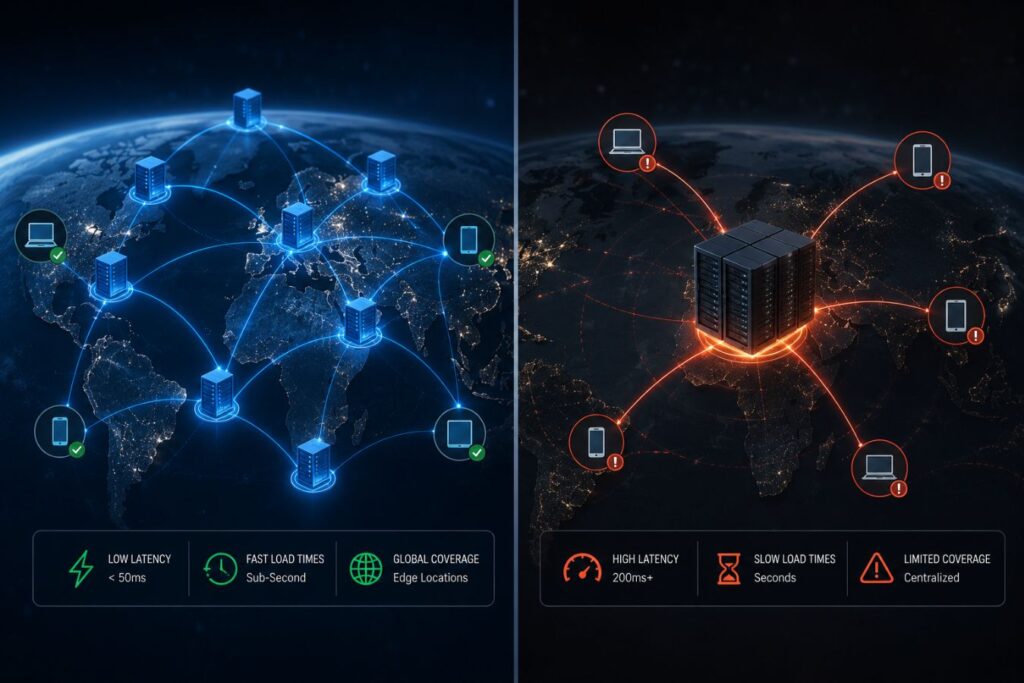
While CDNs are fantastic for caching static assets like images, CSS, and 2D Lottie animations, they cannot process live data.
A CDN serves static files. An Edge Database serves dynamic, user-specific logic.
| The Technology | What It Stores | How It Operates |
| Traditional CDN | Images, Fonts, JavaScript, Videos. | Passively caches unchanging files close to the user. |
| Edge Compute | Authentication logic, API routing. | Executes server-side code physically close to the user. |
| Edge Database | Live user data, financial records, inventory. | Replicates and serves dynamic SQL/NoSQL queries regionally. |
Over our 9+ years of engineering full-stack platforms, we have seen massive ROI when companies upgrade from basic CDNs to true edge databases.
You must cache the data, not just the images, to achieve true enterprise speed.
Pairing Edge Databases with Next.js
Deploying a global database is only half of the solution. You must pair it with a frontend framework capable of exploiting that speed.
Modern enterprise architecture requires a seamless bridge between the user interface and the backend data layer.

This is why combining an Edge Database with a Next.js frontend deployed on a global network (like Vercel) creates an unstoppable digital ecosystem.
How Next.js maximizes edge database performance:
- Edge Rendering: Next.js can execute its server-side rendering (SSR) directly at the edge, fetching data from the local edge database in under 10 milliseconds.
- Zero-Latency State: By utilizing edge networks, your Next.js application paints the complex UI grid instantly, completely eliminating Cumulative Layout Shift (CLS).
- Frictionless Fallbacks: If a specific database node goes offline, the global edge network instantly reroutes the Next.js query to the next closest node with zero visible downtime.
When your frontend and your database share the exact same global architecture, the user experience feels as fast as a downloaded app.
How the Architecture Works
When a user visits a Next.js application running at the edge, both the application logic and database queries can execute in a region close to that user.
The process typically follows this flow:
| Step | Action | Result |
|---|---|---|
| 1 | User sends a request | Request reaches the nearest edge location |
| 2 | Next.js Edge Runtime processes the request | Faster server-side execution |
| 3 | Edge database receives the query | Data is fetched from a nearby replica |
| 4 | Response is generated | Reduced network travel time |
| 5 | Content is delivered to the user | Faster page loads and interactions |
Because both compute and data are geographically distributed, the overall experience becomes noticeably faster.
How Database Latency Ruins UI/UX Design
At Creative Riz, we constantly remind enterprise clients that aesthetics rely entirely on backend architecture. You can design the most breathtaking, breathable data grid in the world, but if your database takes three seconds to respond, the design is ruined.

Sluggish data forces you to plaster your pristine interface with chaotic loading spinners and skeleton screens, instantly destroying the executive experience.
Key Performance Statistics: The True Cost of UI Latency
- The Bounce Threshold: Industry research indicates that 53% of users will abandon a platform if the interface takes longer than 3 seconds to respond.
- The Conversion Drop: A mere 1-second delay in backend data retrieval can result in up to a 20% reduction in overall enterprise conversions.
- The Retention Tax: 88% of users are less likely to return to an application after experiencing severe performance friction, directly spiking B2B churn rates.
Here is exactly how migrating to an Edge Database actively protects and elevates your UI/UX aesthetic:
- Instantaneous Transitions: When data loads in 50 milliseconds from a local edge node, you completely eliminate the need for loading screens. The UI snaps into place seamlessly, projecting a premium, native-app feel.
- Micro-Interaction Polish: Lightning-fast data enables complex filtering, hover states, and visual dashboards to react instantly to the user’s cursor, keeping high-level decision-makers deeply engaged.
- Preserving Whitespace: By eliminating clunky timeout warnings and error messages caused by global latency, your carefully engineered extreme whitespace remains intact, preserving total cognitive ease.
Elite design requires elite engineering. You simply cannot dominate the global B2B market with a beautiful visual shell hiding a bottlenecked, lagging engine.
Mini Case Snapshots: The ROI of Edge Data
Theoretical engineering principles are only valuable if they solve real business bottlenecks and drive revenue. Transitioning heavy queries to the edge has a direct, measurable impact on user retention and global conversion rates.
Here is how Edge Databases solve massive operational challenges:
Case Study Snapshot: The Global SaaS Dashboard
- The Bottleneck: A B2B software company based in the US was losing high-ticket clients in Europe and Asia. Their centralized US database caused 4-second load times for international users, leading to massive UI frustration.
- The Solution: We migrated their read-heavy analytics queries to an Edge Database network. We paired this with a globally distributed Next.js frontend architecture.
- The ROI: Latency for European and Asian users dropped from 3,000ms to 45ms. The software felt instantly responsive globally, eliminating the regional churn rate and increasing international renewals by 35%.
Case Study Snapshot: The High-Volume E-Commerce API
- The Bottleneck: A digital marketplace struggled during peak promotional hours. Their single monolithic database would throttle under the weight of thousands of simultaneous inventory checks, crashing the checkout process.
- The Solution: We decoupled their inventory read queries and deployed them to an Edge Database, ensuring users queried local regional nodes instead of hitting the primary master database.
- The ROI: The primary server load dropped by 80%. The company sustained their highest traffic day in history with zero downtime, securing a flawless checkout experience for every single global buyer.
Executing the Edge Migration Safely
Migrating from a legacy centralized database to a distributed edge network requires careful planning. You cannot simply flip a switch.
Moving data too quickly without proper architecture can result in synchronization errors and corrupted relational logic.
You must audit your queries and migrate the heaviest, safest workloads first.

Here is the precise framework for transitioning to the Edge:
- Phase 1: Identify Read-Heavy Queries: Audit your backend (like your Laravel APIcontrollers) to find endpoints that only read data. Analytics dashboards and product catalogs are the perfect first candidates.
- Phase 2: Deploy the Read Replicas: Spin up Edge Database nodes in your primary global markets. Sync them with your main database using an eventual consistency model.
- Phase 3: Update the Query Logic: Adjust your Next.js frontend or backend middleware to route all “GET” requests to the local edge node, while sending “POST” or “PUT” write requests to the master database.
- Phase 4: Monitor and Scale: Use real-time telemetry to monitor the new latency metrics. Once stability is proven, begin migrating heavier user-state queries to the edge.
By executing this migration in calculated phases, you protect your core business logic while systematically upgrading the global user experience.
Final Thoughts: The End of the Loading Spinner
The modern internet operates on a standard of immediacy.
When you operate remotely and serve a global market, you cannot allow geographic distance to dictate the quality of your digital product.
Forcing an executive in London to wait for a database in New York is an operational failure. It destroys your UI/UX, spikes cognitive load, and actively harms your brand’s authority.
The Edge Database is the ultimate operational solution. It physically bridges the gap between your data and your users.
Stop relying on monolithic architectures that bottleneck your growth.
Bring your data to the edge, secure sub-second load times, and turn your platform into an untouchable, globally scalable enterprise asset.
Frequently Asked Questions (FAQs)
1. Does migrating to an Edge Database compromise our data security?
No. In fact, edge networks often enhance security. Premium edge database providers utilize enterprise-grade encryption at rest and in transit. Furthermore, because your data is distributed, edge networks provide massive resilience against localized DDoS attacks, as traffic is absorbed by hundreds of regional nodes rather than overwhelming a single centralized server.
2. Are Edge Databases suitable for highly transactional data, like processing live financial payments?
Currently, edge databases are best utilized for read-heavy operations where extreme speed is required (like loading dashboards, product catalogs, or user profiles). For strict, high-stakes transactional data (like finalizing a bank transfer), you still route those specific “write” queries to a strongly consistent master database to guarantee absolute mathematical accuracy before replicating it back to the edge.
3. Will our development team have to learn an entirely new query language to use this?
Not necessarily. The operational tech industry has evolved rapidly. Many modern edge database platforms are fully compatible with standard SQL or provide seamless Prisma/ORM integrations. Your developers can often write the exact same queries they always have, while the underlying edge infrastructure handles the complex global distribution and routing automatically.
About the Author