The Decoupled Advantage: Why Migrating Monolithic Systems to a Laravel Backend and Next.js Frontend Secures Enterprise Scalability
The Breaking Point of Legacy Systems
The era of the “all-in-one” server is coming to a painful end for high-growth businesses.
When your user interface, database logic, and security protocols are tightly bound together in a legacy monolithic architecture, you carry massive operational risk. A sudden spike in frontend web traffic can easily crash your backend database, taking your entire business offline.
Today, securing enterprise scalability requires a fundamental shift in how we engineer software.
💡 Executive Insight: The Cost of the Monolith
Sticking with bloated, monolithic platforms (like older WordPress builds or aging PHP frameworks) caps your revenue potential. When your architecture cannot scale flexibly, you suffer from slow load times, frustrated users, and a plummeting organic search ranking.
Today, we are unpacking the financial and technical power of “Decoupled Architecture.” We will explore why pairing a robust Laravel backend with a blazing-fast Next.js frontend is the ultimate enterprise standard.
By the end of this guide, you will understand how this migration drastically improves your security, supercharges your SEO, and future-proofs your digital brand.
What Exactly is a Decoupled System?
In a traditional monolithic system, everything lives in the same digital box. The server processes the database query, builds the HTML, and sends it to the user all at once.
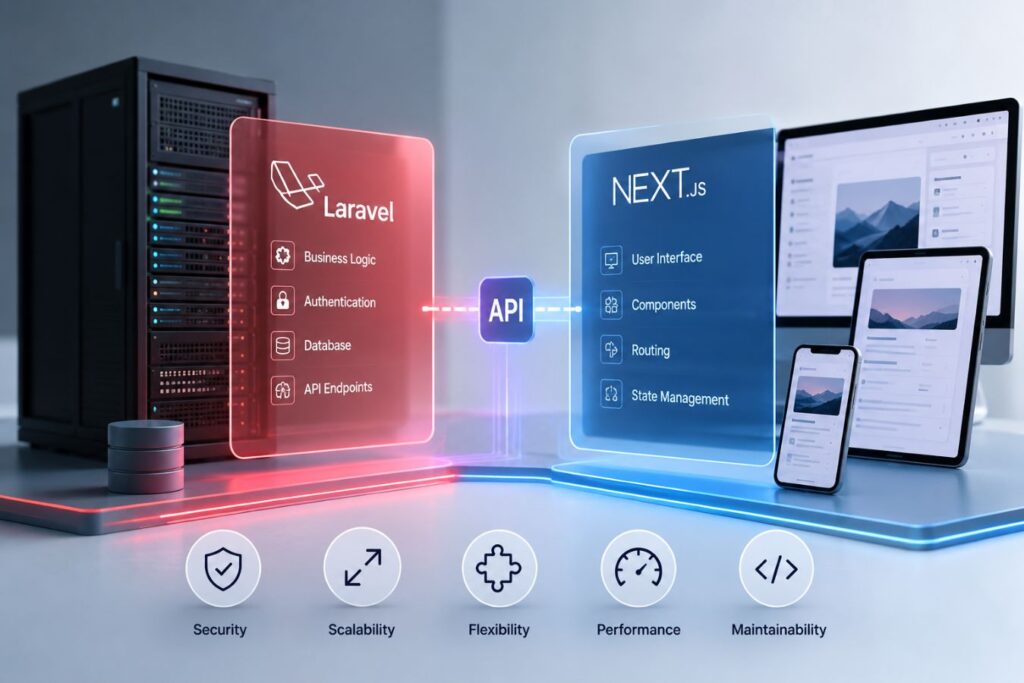
A decoupled (or “headless”) architecture violently separates these responsibilities.
The backend (the brain) and the frontend (the face) become two completely independent systems that communicate exclusively through secure Application Programming Interfaces (APIs).
Monolithic vs. Decoupled
- The Monolith (The Legacy Way): Code, database, and design are tangled together. Updating the design requires touching the core database logic, risking catastrophic system breaks.
- The Decoupled Way (The Modern Standard): The backend sits safely behind a firewall, managing data. The frontend lives on a global edge network, delivering lightning-fast visuals to the user.
- The API Bridge: They communicate via secure, encrypted JSON payloads. If the frontend crashes, the backend data remains perfectly safe and untouched.
Laravel: The Ironclad Data Engine
When decoupling a system, your backend no longer cares what your website looks like. Its only job is to process complex business logic securely and efficiently.
For enterprise B2B platforms, Laravel is the undisputed champion of backend PHP frameworks.

It provides an elegant, highly secure environment capable of managing millions of database rows without breaking a sweat.
Here is why enterprise CTOs demand Laravel for their backend architecture:
| The Engineering Feature | The Technical Benefit | The Executive ROI |
| Eloquent ORM | Interacts with complex databases intuitively, preventing SQL injection attacks naturally. | Protects proprietary company data and ensures flawless security compliance. |
| Advanced Middleware | Interrogates every single API request before it ever reaches your core application logic. | Blocks malicious AI botnets and scrapers from stealing your enterprise resources. |
| Task Queues | Offloads heavy processes (like generating massive PDF reports) to background workers. | Keeps the main server lightning-fast, ensuring zero downtime during peak business hours. |
Consider the complexities of enterprise user management. When engineering comprehensive data management systems, granular control is absolutely non-negotiable.
By utilizing Laravel’s Spatie permission packages, we can effortlessly restrict module access. For example, ensuring only “Super Admins” can view sensitive enrollment logs, while standard managers cannot.
This level of robust, airtight logic is exactly what makes Laravel the perfect backend engine for complex digital products.
Next.js: The Speed Demon of the Edge
If Laravel is your impenetrable data vault, Next.js is your high-speed delivery vehicle. Built on React, this modern framework is explicitly engineered to dominate the AI-driven internet.

When you migrate your frontend to Next.js, your users no longer have to wait for a struggling, centralized server to slowly assemble their web pages.
Instead, Next.js pre-builds your digital assets and caches them globally on a Content Delivery Network (CDN) known as the “Edge.”
Here are the strategic advantages of moving your enterprise frontend to Next.js:
- Sub-Second Load Times: Because pages are pre-rendered and served from local CDN nodes, users experience near-instantaneous loading. This mathematically guarantees dominance over Google’s Core Web Vitals.
- Flawless SEO Capability: Unlike older React applications that struggled to index, Next.js delivers fully rendered HTML directly to Google’s crawlers. This ensures your high-ticket content ranks perfectly.
- Frictionless UI/UX: Page transitions happen in milliseconds without ever triggering a full browser reload. This keeps your enterprise users locked in a highly productive, frustration-free “flow state.”
Whether you are managing a global brand or scaling aggressively within the Pakistani tech ecosystem, delivering localized edge-speed is your ultimate competitive advantage.
Performance Check: The “Blink” Test Open a new browser tab right now and click on your company’s current website. Did you see a white screen or a loading spinner for even a split second? If you can blink your eyes before the page fully renders, your legacy server is actively burning your marketing budget. Modern edge-delivered websites do not load; they simply appear.
Unleashing Creative Freedom
There is a massive, often overlooked benefit to decoupled architectures: total creative freedom.
In a monolithic WordPress build, your designers are severely limited by heavy themes, clunky page builders, and rigid database structures.
When you decouple with Next.js, those creative chains are completely broken. Your design team can build whatever they want.
How a decoupled architecture empowers premium brand aesthetics:
- Bespoke Interactions: We can engineer custom CSS micro-interactions and smooth 2D motion graphics that simply would not run efficiently on a legacy system.
- No Plugin Bloat: Designers no longer have to rely on slow, third-party plugins to create unique layouts. Everything is hard-coded into hyper-efficient React components.
- Omnichannel Branding: Because your Laravel backend serves raw data via API, you can use that exact same data to power an iOS app, a web dashboard, and a smartwatch interface simultaneously.
This allows us to prioritize professional, minimal, and corporate aesthetics without ever worrying about slowing down the server.

Faster Design Iteration Cycles
Modern businesses cannot afford lengthy redesign projects. Customer expectations change rapidly, and digital experiences must evolve just as quickly.
A decoupled Laravel and Next.js architecture enables rapid iteration because frontend changes can often be deployed independently of backend updates. This means teams can:
- Launch new landing pages faster
- Improve user interfaces based on customer feedback
- Conduct A/B testing with minimal disruption
- Experiment with conversion-focused layouts
- Refine branding elements without backend redevelopment
As a result, companies can continuously improve their digital products rather than waiting for major release cycles.
Empowering Specialized Teams
One of the greatest advantages of decoupling is that it allows each team to focus on its area of expertise.
| Team | Primary Focus in a Monolithic System | Primary Focus in a Decoupled System |
|---|---|---|
| Frontend Developers | Work around backend templates and restrictions | Build engaging, modern user experiences |
| Backend Developers | Manage business logic and frontend dependencies | Focus on APIs, security, and performance |
| UI/UX Designers | Limited by technical constraints | Create innovative and user-centered designs |
| Marketing Teams | Depend heavily on developers for updates | Launch campaigns and content more efficiently |
| Product Managers | Coordinate tightly coupled releases | Manage independent development workflows |
This division of responsibilities reduces friction between teams and accelerates project delivery.
Case Study Snapshots: The Decoupled Migration
Theoretical architecture is meaningless if it does not solve real-world revenue bottlenecks. Migrating away from a monolith requires a strategic, phased approach.
Here is how replacing legacy systems with a decoupled Laravel/Next.js stack directly impacts enterprise ROI.
Case Study Snapshot: The Global B2B Directory
- The Bottleneck: A massive industry directory was built on a monolithic legacy framework. As their database grew to over 100,000 entries, server queries choked. Load times exceeded 6 seconds, and SEO rankings plummeted.
- The Migration: We migrated their backend to a headless Laravel structure and rebuilt the frontend using Next.js. We utilized Incremental Static Regeneration (ISR) to cache their massive directory at the edge.
- The ROI: Page load times dropped to 0.4 seconds. The system easily handled a 300% surge in global traffic without increasing server costs, and their organic lead generation doubled within a quarter.
Case Study Snapshot: The Custom SaaS Tool
- The Bottleneck: A company running a complex image-resizer tool found that their monolithic architecture was constantly crashing when multiple users uploaded heavy files simultaneously.
- The Migration: We decoupled the application. The heavy image-processing scripts were moved securely to a background Laravel queue, while Next.js handled the sleek, real-time user interface.
- The ROI: The platform achieved 100% uptime. Users experienced a smooth, frictionless interface that instantly reported processing status, drastically reducing churn and establishing immense brand trust.
The ROI of Future-Proofing

Re-architecting your enterprise platform is a significant capital investment, but executives must stop viewing this migration as a sunk IT expense. While a legacy monolithic system actively limits your growth, a decoupled architecture mathematically lowers your long-term maintenance costs and operational risks.
By physically separating your frontend from your backend, you immediately unlock structural financial advantages:
- Eliminate Scalability Bottlenecks: You completely remove the technical ceiling on your digital growth, allowing infinite frontend scaling.
- Optimize Resource Allocation: You stop paying for massive, expensive server upgrades just to handle surface-level website traffic spikes.
- Protect Brand Valuation: By disconnecting the database from the public interface, you neutralize catastrophic security threats before they happen.
To secure boardroom buy-in, here are the hard financial metrics of a decoupled upgrade:
| The Decoupled Advantage | The Technical Reality | The Boardroom Metric (The ROI) |
| Independent Scaling | Scale server resources for the frontend without paying to scale the backend. | Reduced DevOps Costs: Stop overpaying for massive servers to handle basic traffic spikes. |
| Developer Velocity | Frontend designers and backend engineers work simultaneously without blocking each other. | Faster Time-to-Market: Deploy new features and marketing campaigns in weeks instead of months. |
| Impenetrable Security | The core database is physically disconnected from the public-facing website. | Catastrophic Loss Avoidance: Complete protection against standard CMS vulnerabilities and SQL injections. |
Strategic Assessment: Is Your Architecture Costing You Market Share?
Take a moment to evaluate the financial health of your current digital infrastructure. Ask yourself and your technical leads:
- The Traffic Test:If our marketing team launches a campaign that triples our website traffic tomorrow, will our backend database crash?
- The Deployment Test:Does our development team measure new feature deployments in “months” instead of “days” because the legacy code is too tangled?
- The Overhead Test:Are we constantly paying for larger server hosting plans just to keep our monolithic CMS running at a basic, acceptable speed?(If you answered “yes” to any of these questions, your current architecture is an active financial liability.)
If you plan to dominate your industry for the next decade, a decoupled Laravel and Next.js stack is the most profitable foundation you can build upon.
Final Thoughts: Escaping the Legacy Trap
The technology that got your business to its first million in revenue is rarely the technology that will take it to ten million.
Clinging to an outdated, monolithic architecture is like trying to win a Formula 1 race in a commuter sedan. It is slow, it is dangerous, and it is costing you market share every single day.
By migrating to a decoupled architecture, you secure the absolute best of both worlds: ironclad backend security and breathtaking frontend speed.
Stop letting legacy technology dictate your company’s ceiling. Take control of your digital infrastructure today.
Frequently Asked Questions (FAQs)
1. Is migrating to a decoupled architecture going to cause SEO downtime?
When executed correctly, absolutely not. In fact, a decoupled migration is often deployed to fix SEO penalties. By utilizing strict 301 redirect mapping and deploying the Next.js frontend to a staging environment first, we ensure search engines instantly recognize the new, significantly faster architecture without dropping a single ranking position.
2. Can my marketing team still easily update content on a headless system?
Yes. A decoupled backend does not mean you lose your Content Management System (CMS). We frequently integrate headless CMS platforms (like Sanity, Strapi, or even a headless WordPress setup) directly into the Next.js frontend. Your marketing team still gets a beautiful, easy-to-use writing dashboard, while the engineering team gets the blazing-fast, secure architecture they require.
3. Why use Laravel instead of Node.js for the backend?
While Node.js is incredibly powerful, Laravel remains the absolute gold standard for complex, data-heavy relational enterprise applications. Laravel’s built-in ecosystem for robust authentication, granular Spatie permissions, queue management, and advanced database migrations allows enterprise teams to build highly secure business logic much faster and more reliably than assembling custom Node.js microservices from scratch.
About the Author