
Beyond the Chatbot: Integrating Proactive AI Sales Agents into Complex B2B Funnels
The Death of the ‟Dumb” Chatbot
Let’s be completely honest: most B2B buyers actively despise traditional chatbots. For the past decade, these tools have been nothing more than glorified, deeply frustrating FAQ menus.
When an enterprise decision-maker lands on your website looking for a $50,000 software solution, they do not want to be forced into a rigid, robotic decision tree. They want immediate, contextual, and highly intelligent guidance.
The era of the reactive, rules-based chatbot is officially over.
💡 Expert Insight: The AI Evolution
We are transitioning from reactive support bots to proactive AI sales agents. These new systems do not just wait to be spoken to; they analyze user behavior, anticipate needs, and actively guide high-ticket leads through complex sales funnels.
Today, we are exploring the architecture of proactive AI sales agents. We will break down exactly how these advanced Large Language Models (LLMs) are completely rewiring B2B lead generation.
By the end of this comprehensive guide, you will understand how to deploy an AI agent that acts like your top-performing human sales rep, operating 24/7.
Reactive vs. Proactive: Understanding the Difference
To build a modern B2B funnel, you must first understand why your current chat widget is likely costing you money. Traditional bots are built on “if/then” logic.

If a user asks a question that falls outside of the pre-programmed script, the bot breaks down, apologizes, and demands an email address. This creates immense friction and instantly destroys market trust.
Proactive AI agents operate on dynamic comprehension, not static scripts.
Here is how the underlying technology has fundamentally shifted the user experience:
| Funnel Element | The Traditional Chatbot | The Proactive AI Agent |
| Engagement Trigger | Waits passively in the corner until the user clicks it. | Analyzes scroll depth and triggers a highly relevant, context-aware greeting. |
| Data Processing | Follows rigid, pre-written conversational trees. | Reads your entire website and product documentation to generate organic answers. |
| Lead Qualification | Asks for a name, email, and company size upfront. | Converses naturally, gathering qualifying data seamlessly throughout the chat. |
| The End Goal | Deflect support tickets or capture an email address. | Educate the buyer, handle technical objections, and book a qualified sales meeting. |
Re-Engineering the Multi-Step Conversion Path
B2B sales are inherently complex. You are rarely selling a simple, one-click product; you are selling custom architectures, long-term retainers, or enterprise software.
The traditional B2B funnel requires the user to read whitepapers, fill out contact forms, and wait 48 hours for a Sales Development Rep (SDR) to email them back. This delay kills momentum.

A proactive AI agent collapses this timeline. It engages the prospect at the exact moment their buying intent is highest.
The AI-Accelerated Funnel
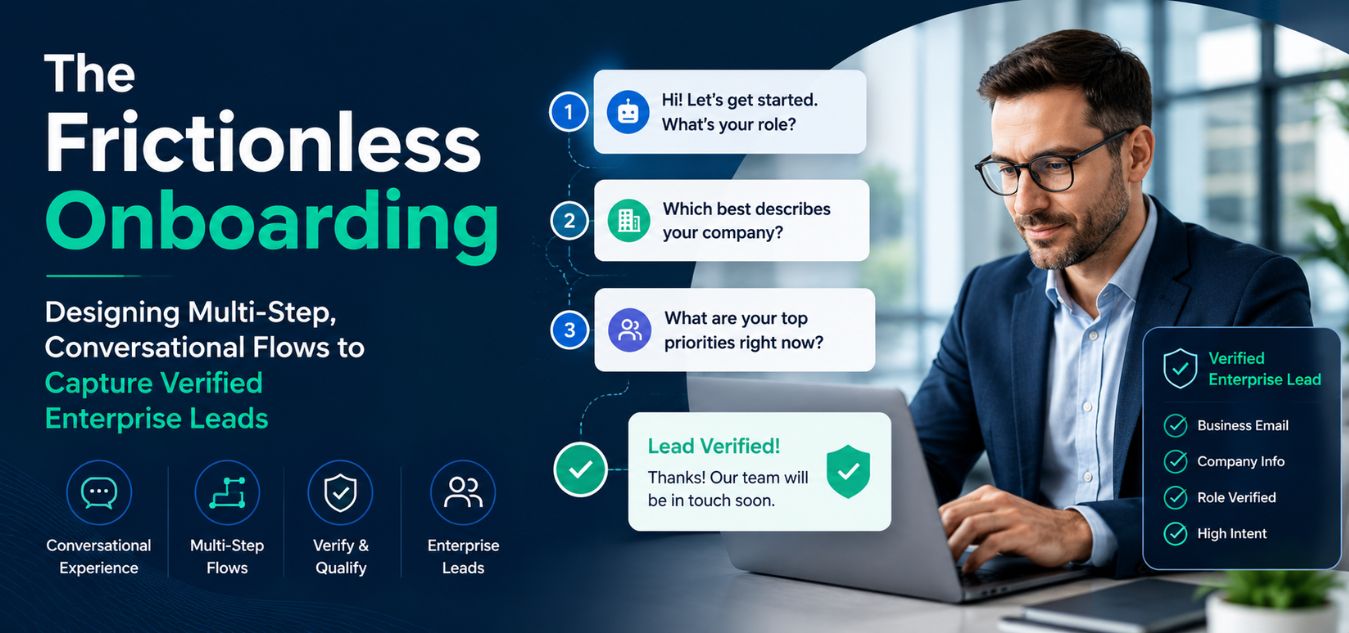
- Phase 1: Contextual Interception. A CTO reads your pricing page for three minutes. The AI agent proactively opens and asks: “I see you’re reviewing our enterprise tiers. Are you currently migrating from a legacy system?”
- Phase 2: Technical Objection Handling. The CTO asks about API security. The AI agent instantly references your company’s documentation on HMAC signatures and IP whitelisting to provide a flawless technical answer.
- Phase 3: Invisible Qualification. While answering questions, the AI subtly asks about data volume and team size, silently scoring the lead in your CRM background.
- Phase 4: The Handoff. The AI determines this is a high-value prospect. It seamlessly offers a calendar link to book a technical demo with your human engineering team for the following day.
The Intelligence Engine: Why Generic AI Kills B2B Sales
An AI agent is only as intelligent as the data you feed it. Deploying a generic Large Language Model (LLM) on your website without proprietary training is a recipe for disaster; it will hallucinate, provide incorrect information, and instantly destroy buyer trust.
To succeed in high-ticket B2B sales, your agent requires absolute contextual mastery of your specific product and operations. This level of intelligence is not a frontend trick; it requires robust backend engineering and secure API connections.
Your developers must build an architecture where the AI can securely query your internal databases in real-time, pulling exactly what it needs to close the deal.

How to Build a Useless AI Agent Want to guarantee your AI deployment fails? Just plug a standard, untrained chatbot widget into your homepage with zero backend connections. It will confidently give your enterprise leads the wrong pricing, ignore their past CRM history, and force high-value prospects to repeat their company name three times before they finally leave your site in frustration.
To build an agent that actually drives revenue, you must engineer these three critical data integrations:
- Knowledge Base Integration (The Brain): Do not let the AI guess. Connect it directly to your technical documentation, closed-won case studies, and historical sales transcripts so it speaks with absolute, verified authority.
- Real-Time CRM Syncing (The Memory): When an existing client logs in and opens the chat, the AI must instantly recognize them. Recalling their name, subscription tier, and past support history creates a frictionless, high-touch enterprise experience.
- Dynamic Custom Pricing (The Closer): If your services require custom quotes, the AI cannot rely on static PDFs. It must be able to securely query your backend pricing logic to calculate accurate, real-time estimates based on the user’s exact parameters.
The Aesthetics of Trust: Why Cheap Design Kills Smart AI
Even the most brilliantly engineered AI agent will fail instantly if it looks like a cheap, early-2000s spam pop-up. In the high-stakes B2B enterprise space, visual design is not just decoration, it is the literal language of security and trustworthiness.

If a corporate executive interacts with a chat window featuring clashing colors, clumsy animations, and an amateur avatar, they will immediately doubt the underlying security of your entire platform.
A premium interface subconsciously tells the user that the artificial intelligence they are speaking to is advanced, secure, and absolutely worth their time.
To understand how aesthetics dictate B2B buying behavior, look at how interface quality directly translates to brand perception:
| UI/UX Execution | The Executive’s Subconscious Perception | The Business Outcome |
| Off-the-Shelf / Generic Plugin | “This company cuts corners and uses cheap third-party tools.” | High bounce rate; loss of technical credibility. |
| Bespoke, Premium Integration | “This platform is highly secure, custom-engineered, and authoritative.” | Sustained engagement; increased high-ticket demo bookings. |
To ensure your AI agent builds trust rather than destroying it, its interface must seamlessly blend into your premium brand identity. You must strictly enforce these three design pillars:
- The Minimalist Corporate Standard: The chat interface must utilize generous negative space, crisp geometric typography, and your exact brand color palette to maintain absolute visual consistency.
- Frictionless Micro-Interactions: Use buttery-smooth animations when the chat window opens or a message is delivered. A UI that stutters or lags subconsciously signals bloated, poorly written code.
- Authoritative Avatars: Banish the generic “clipart robot” icons permanently. Use bespoke, abstract brand marks or high-fidelity, stylized portraits to give the agent a sophisticated presence.
What Executives Spot Instantly
Enterprise buyers are highly trained to spot operational risk. When they engage with your website, they are looking for reasons to disqualify you. If your AI agent displays any of these visual or behavioral red flags, the trust is broken immediately.
Avoid these critical design failures that scream “amateur” to a high-level prospect:
| The Red Flag Indicator | What It Actually Tells Your Prospect | The Required Fix |
| Pixelated or Generic Avatars | “We do not pay attention to detail, and our product is likely just as sloppy.” | Upload crisp, SVG-based brand icons or professional headshots. |
| Default Brand Colors (e.g., Bright Blue) | “This is an uncustomized, cheap plugin we pasted onto our site.” | Force the widget’s CSS to inherit your website’s exact hex codes. |
| Aggressive, Shaking Pop-Up Animations | “We are desperate for your attention and do not respect your browsing experience.” | Use smooth, delayed fade-in micro-interactions that feel helpful, not intrusive. |
Mini Case Snapshots: AI in Action
Theoretical strategies sound great, but real-world execution is where revenue is won or lost. Implementing proactive AI requires a deep understanding of human buyer psychology.
Here is how optimizing for proactive, intelligent engagement solves massive conversion bottlenecks in real-world B2B scenarios:
Mini Case Snapshot: The Custom Software Agency
- The Bottleneck: An agency was getting high traffic to their services page, but their standard “Contact Us” form had a dismal 2% conversion rate. Prospects didn’t want to fill out a long form just to ask a quick pricing question.
- The AI Fix: They replaced the form with a proactive AI agent trained on their entire portfolio. If a user lingered on an e-commerce case study, the AI proactively asked, “Are you looking to scale a headless commerce platform?”
- The ROI: The AI answered basic technical questions instantly, building trust. Lead capture increased by 310%, and the human sales team only spoke to highly qualified, pre-educated prospects.
Mini Case Snapshot: The SaaS Security Platform
- The Bottleneck: An enterprise cybersecurity platform was losing leads because their software was highly complex. Prospects were overwhelmed by the documentation and bouncing off the site before booking a demo.
- The AI Fix: They deployed an AI agent trained specifically on their technical API documentation. It was designed to translate complex cryptography concepts into simple business benefits in real-time.
- The ROI: Average time-on-page doubled. By allowing CTOs to interrogate the AI about specific security protocols (like strict IP whitelisting), the platform proved its technical authority instantly, driving a 45% increase in booked enterprise demos.
Step-by-Step: Deploying Your AI Sales Agent
Integrating a proactive AI agent into your digital infrastructure is not a weekend project. It requires meticulous planning, precise technical execution, and rigorous testing.
Rushing this process can result in an AI that hallucinates incorrect pricing or aggressively annoys your website visitors.
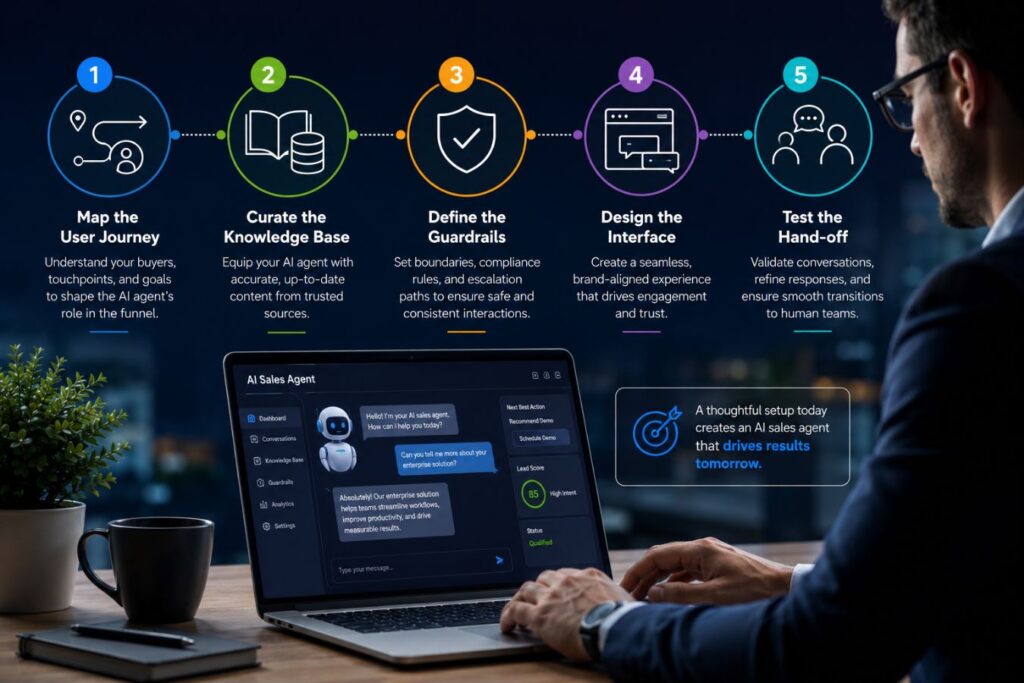
Follow this strict integration checklist to guarantee a frictionless rollout:
- Map the User Journey: Identify the exact moments of friction on your website. Where do users typically bounce? These are the precise locations where your AI should proactively intervene.
- Curate the Knowledge Base: Gather your best sales scripts, technical whitepapers, and pricing matrices. Clean this data meticulously; the AI will treat whatever you feed it as absolute truth.
- Define the Guardrails: Program strict boundaries. If a user asks a highly sensitive legal or custom-pricing question, the AI must seamlessly pivot and seamlessly route the conversation to a human executive.
- Design the Interface: Work with a premium UI/UX team to ensure the chat widget feels like an exclusive, high-end feature rather than a generic third-party plugin.
- Test the Hand-off: Ensure the API connection between the AI agent and your CRM (like Salesforce or HubSpot) is flawless. When the AI books a meeting, the human rep needs the entire chat transcript attached to the calendar invite instantly.
Final Thoughts: The Human-AI Partnership
The goal of a proactive AI sales agent is never to completely replace your human sales team. In the enterprise B2B space, high-ticket deals will always be closed by human beings building genuine relationships.
The true power of AI lies in scale and velocity.
By deploying an intelligent agent, you eliminate the tedious hours your team spends answering basic questions and qualifying cold traffic. You allow your human experts to focus 100% of their energy on closing deals that the AI has already teed up.
The transition from reactive chatbots to proactive AI agents is happening right now. If your website is still relying on a static contact form, you are actively losing market share to competitors who offer immediate, intelligent conversations.
Frequently Asked Questions (FAQs)
1. How do we prevent the AI agent from hallucinating or giving wrong information?
The key to preventing hallucinations is “Retrieval-Augmented Generation” (RAG). Instead of letting the AI guess based on its general internet training, you constrain the LLM to only pull answers from your proprietary, uploaded database. You also establish strict behavioral guardrails: if the AI cannot find the answer in your specific documents, it is programmed to say, “I don’t have that exact technical detail, let me connect you with an engineer.”
2. Will an AI agent negatively impact our website’s loading speed?
If implemented correctly, the impact is negligible. Modern AI chat widgets are built using asynchronous JavaScript loading. This means your core website content, images, and layout load instantly first, and the AI script loads in the background without blocking the user’s experience. Ensuring this requires clean, optimized frontend development practices.
3. At what point should the AI hand the conversation over to a human?
This depends on your specific sales cycle, but the general rule is “upon qualification.” The AI should handle the initial greeting, answer technical FAQs, and gather the user’s company size and core problem. Once the prospect meets your specific criteria for a “Qualified Lead,” the AI should immediately offer a calendar link or trigger a live-chat notification for a human rep to take over the conversation seamlessly.
About the Author