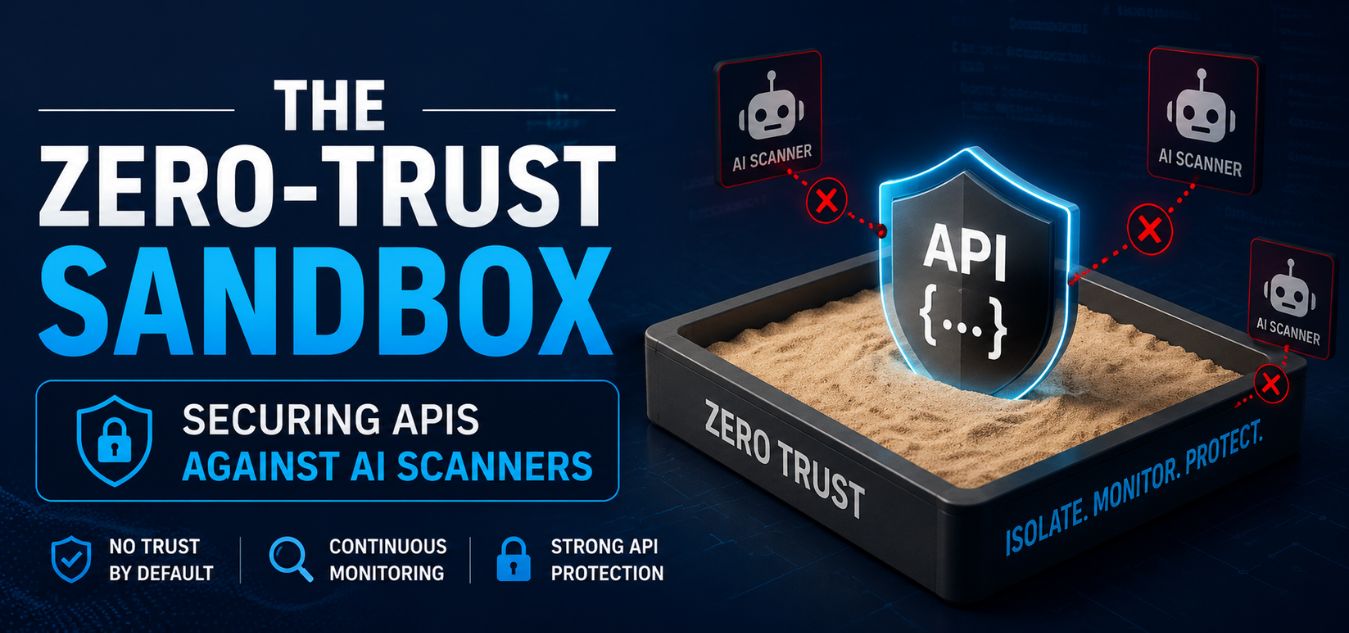
The Zero-Trust Sandbox: How to Proactively Test Your Production APIs Against Automated, AI-Driven Vulnerability Scanners
The New Era of Automated Cyber Threats
We are no longer just fighting human hackers. The landscape of enterprise cybersecurity has fundamentally shifted.
Today, B2B platforms are under constant siege by automated, AI-driven vulnerability scanners. These autonomous bots aggressively map your endpoints, looking for the smallest crack in your architecture.
If your backend is built on legacy assumptions, these AI agents will find a way in. They do not sleep, they do not tire, and they operate at machine speed.
🛡️ Executive Insight: The Cost of Complacency
Treating API security as an afterthought is a massive corporate liability. A single breached endpoint can expose your entire customer database, destroying years of brand equity overnight. You must shift from reactive patching to proactive, automated defense.
Today, we are unpacking the mechanics of the “Zero-Trust Sandbox.” This is how you beat AI bots at their own game.
By the end of this guide, you will understand how to rigorously test your production APIs and secure your digital infrastructure against the next generation of automated threats.
Understanding the AI-Driven Scraper
To build a proper defense, you must understand the enemy. Modern vulnerability scanners are not just running simple SQL injection scripts anymore.

These AI-driven bots utilize machine learning to mimic legitimate user behavior. They bypass standard rate limits by rotating IP addresses across massive, global proxy networks.
They are specifically hunting for logical flaws in your application, such as Broken Object Level Authorization (BOLA).
Here is how modern AI scanners differ from traditional cyber threats:
| Threat Metric | Traditional Hackers | AI-Driven Vulnerability Scanners |
| Speed & Scale | Manual, targeted, and limited by human processing speed. | Scans thousands of endpoints per second, running 24/7. |
| Behavioral Pattern | Predictable patterns easily blocked by standard firewalls. | Mimics human delays and alters request headers to avoid detection. |
| Primary Target | Outdated software versions and known CVE vulnerabilities. | Undocumented API endpoints, weak authentication, and BOLA flaws. |
| Adaptability | Relies on pre-written scripts and known exploits. | Learns from server responses, actively adjusting its attack vectors. |
Building systems in high-growth regional markets requires anticipating these sophisticated attacks. When developing enterprise software that handles critical institutional data, standard security defaults are never enough.
What is a Zero-Trust Sandbox?
“Zero-Trust” is not just a corporate marketing buzzword used to sell cybersecurity subscriptions. It is a ruthless, unforgiving architectural philosophy that operates on a single rule: trust absolutely no one.
This framework assumes that every single request, even traffic originating from deep inside your own internal network, is inherently hostile and actively compromised.
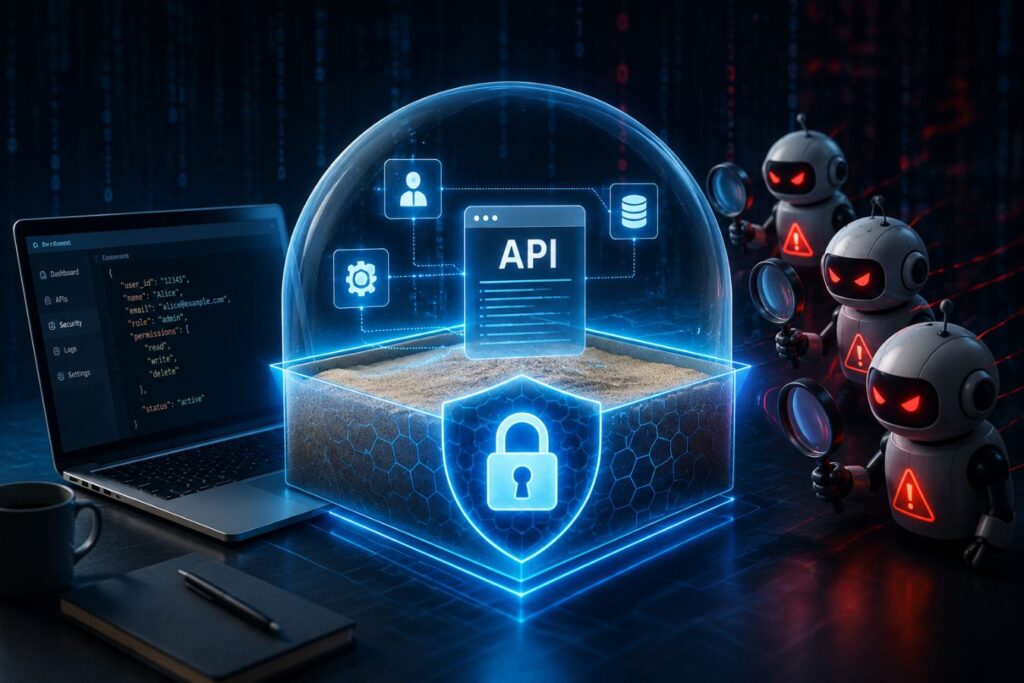
A Zero-Trust Sandbox takes this paranoid philosophy and transforms it into a physical engineering environment. It is a highly controlled, perfectly isolated replica of your live production server, built with one specific purpose in mind.
The Goal is Destruction, Not Perfection
Executives often view testing environments as safe spaces designed to prove that a new software feature works. This is a fatal misconception. A true Zero-Trust Sandbox is built specifically to be destroyed. You are not trying to validate your pristine code; you are actively trying to shatter it. The goal is to expose the exact moment your logic fails under extreme duress, allowing you to patch the fatal flaw before deployment.
To survive modern AI-driven attacks, you must shift your engineering approach from passive defense to active aggression:
| The Security Paradigm | The Traditional Testing Mindset | The Zero-Trust Sandbox Reality |
| The Core Assumption | Internal network traffic is generally safe and trustworthy. | Every single incoming request is inherently hostile and compromised. |
| The Testing Objective | Verifying that new features function correctly without bugs. | Actively trying to shatter the architecture and break the server logic. |
| The Threat Simulation | Running manual, basic QA tests on web forms. | Unleashing autonomous AI botnets directly against the API endpoints. |
To safely execute this controlled chaos, the sandbox must be engineered using a strict, four-pillar anatomy:
- The Isolated Clone: A perfect mirror image of your production server, built entirely with synthetic, generated data to ensure real user PII (Personally Identifiable Information) is never at risk.
- The AI Adversary: We deploy our own highly aggressive, automated AI vulnerability scanners directly against the sandbox to mimic real-world threat actors.
- The Middleware Shield: We force every payload through severe authentication layers, interrogating the traffic at the gateway level before it ever touches the database.
- The Telemetry Grid: The system logs every single blocked payload, bypassed token, and rate-limit trigger in real-time for immediate forensic analysis.
Here is how those structural pillars translate into actionable backend engineering:
| Sandbox Component | The Technical Execution | The Enterprise Security Value |
| The Artificial Target | Deploying synthetic databases to mimic high-value enterprise records. | Allows your team to simulate catastrophic data breaches without legal liability. |
| The Authorization Gate | Implementing strict Laravel middleware and Spatie permission systems. | Instantly blocks lateral movement, ensuring standard users cannot access admin roles. |
| The Forensic Grid | Capturing the exact header mutations and IPs used by the AI scanner. | Provides the exact mathematical blueprint needed to write proactive security patches. |
By actively and aggressively attacking our own infrastructure, we discover exactly where the architecture will snap before a malicious actor ever gets the chance.
Proactive Sandbox Testing Strategies
Over our 9+ years of engineering digital experiences, we have developed a rigorous testing methodology. We recently implemented a production-grade API security sandbox to test specific vulnerabilities.
We ran 10 distinct security best practices against relentless AI-driven attacks. The results proved that basic API keys are fundamentally useless against modern bots.
To truly secure your system, your sandbox must rigorously test these critical defense layers.
The Core Vulnerability Tests Your Sandbox Must Pass:
- Broken Object Level Authorization (BOLA): Can User A manipulate the API endpoint to view or delete User B’s private account data?
- HMAC Signature Validation: Are you using Hash-based Message Authentication Codes (HMAC) to ensure request payloads have not been tampered with in transit?
- Strict IP Whitelisting: Is the API actively rejecting traffic from unauthorized global regions and known proxy server networks?
- Dynamic Rate Limiting: Does the system automatically throttle requests when a single IP makes 500 requests in a fraction of a second?
- Token Expiration & Rotation: Are your JSON Web Tokens (JWT) configured to expire rapidly, forcing the client to continuously re-authenticate?
When your backend architecture successfully mitigates all of these vectors in the sandbox, you can deploy to production with absolute confidence.
Security as a Premium Brand Asset

There is a massive misconception that high-level security ruins the user experience. Executives often worry that strict authentication will frustrate their premium clients.
This is a failure of digital design. Elite UI/UX seamlessly hides complex security protocols from the end user.
True digital luxury means the user feels completely protected without ever being bogged down by clunky security barriers.
How we blend ironclad backend security with premium frontend design:
| The Security Protocol | The UX Friction (The Pain) | The Design Solution (The Fix) |
| Strict Authentication | Forcing users to manually log in every 10 minutes when their token expires. | Engineering silent, background token-refresh protocols using Next.js decoupled frontends. |
| Rate Limiting | Showing a harsh, technical “Error 429: Too Many Requests” plain-text page. | Designing a beautifully branded, gentle CSS notification explaining the temporary pause. |
| Fraud Detection | Blocking legitimate enterprise users because their IP address slightly changed. | Implementing intelligent, multi-factor verification flows that are quick and frictionless. |
A secure backend is the foundation of a premium brand. It allows your frontend interface to operate with absolute stability, projecting confidence to your high-ticket buyers.
Step-by-Step: Testing Against AI Scanners
If you are a CTO or lead developer, you cannot simply hope your firewall holds. You must actively stress-test your own APIs using the same tools the attackers use.
Setting up a Zero-Trust Sandbox requires precision. You must simulate the exact behaviors of an AI-driven scraper to test your middleware logic.
Here is the exact framework for executing a proactive vulnerability scan.
- Phase 1: Environment Isolation: Never test on production. Spin up a separate staging server with an identical Laravel or Node.js backend. Populate the database with synthetic, generated user data.
- Phase 2: Deploying the Aggressor: Utilize automated security scanners like OWASP ZAP or specialized AI fuzzing tools. Point these tools directly at your sandbox endpoints.
- Phase 3: The Payload Mutation: Configure the AI scanner to mutate its payloads. It should automatically swap user IDs, alter request headers, and test for SQL injections simultaneously.
- Phase 4: Monitoring the Middleware: Watch your application logs closely. Is your Laravel Spatie permission system correctly identifying and blocking unauthorized role access?
- Phase 5: The Post-Mortem: After the automated attack finishes, analyze every single successful breach. Patch the logic flaw, update your HMAC signature requirements, and run the test again.
This iterative process transforms your backend from a fragile target into an impenetrable fortress.

Monitor Logs and Security Telemetry
Testing does not end after running the scanner. The real value comes from analyzing the telemetry generated during the assessment.
Security teams should review:
- API gateway logs
- Authentication events
- Suspicious request patterns
- Error spikes
- Latency anomalies
- Threat detection alerts
This visibility helps teams understand not only which vulnerabilities exist, but also how attackers might realistically approach exploitation.
Case Snapshots: The Value of Proactive Defense
Theoretical security concepts only matter if they protect real-world revenue. Waiting for a breach to occur before upgrading your architecture is a catastrophic business strategy.
Here is how implementing proactive sandbox testing directly solves massive enterprise bottlenecks:
Case Study Snapshot: The Logistics API
- The Threat: A regional supply chain platform noticed their proprietary shipping rates were being actively scraped by a competitor’s AI bot.
- The Sandbox Solution: We isolated their endpoints in a sandbox and tested dynamic HMAC signature implementation. We engineered the backend to require a unique, time-stamped cryptographic hash for every single pricing request.
- The Result: The competitor’s AI scraper immediately failed. It could not guess the dynamic cryptographic keys, completely securing the client’s proprietary data and protecting their competitive advantage.
Case Study Snapshot: The Institutional Portal
- The Threat: A large-scale public sector portal was experiencing severe server throttling due to automated botnets attempting to bypass firewall permissions.
- The Sandbox Solution: We replicated the server environment and stress-tested advanced Laravel middleware combined with strict regional IP whitelisting and dynamic rate limiting.
- The Result: We successfully mapped out the exact rules needed for the institutional firewall. Once pushed to production, malicious bot traffic dropped by 98%, restoring perfect server response times for legitimate users.
The ROI of Zero-Trust Architecture

Upgrading to a Zero-Trust architecture requires a serious investment of development hours and technical resources. Because of this, executives constantly demand to see the direct financial return on investment before approving the budget.
When evaluating this initiative, you have to stop looking at security as a sunk IT cost. The true ROI of cybersecurity is measured in massive loss avoidance, absolute operational continuity, and the preservation of your brand’s valuation.
When you proactively secure your enterprise APIs, you are actively defending your corporate revenue.
Myth vs. Reality: The Security Investment
The Industry Myth: Cybersecurity is just an expensive IT insurance policy that slows down your development team and adds friction to the user experience. The Enterprise Reality: Proactive security is a massive revenue driver. Passing a Fortune 500 compliance audit on the first try actively accelerates high-ticket sales and closes enterprise contracts.
To secure buy-in from your board of directors, frame the financial benefits of a Zero-Trust Sandbox around these three core pillars:
- Eliminating Ransomware Leverage: By proactively patching BOLA vulnerabilities inside a sandbox, you destroy a hacker’s ability to access sensitive data. This completely removes their extortion leverage and protects you from multi-million dollar ransoms.
- Protecting Intellectual Property: Autonomous AI scrapers are built to steal your proprietary pricing models, content, and client lists. Blocking them preserves your unique market advantage and prevents competitors from undercutting you.
- Securing Enterprise Contracts: Fortune 500 companies run ruthless, uncompromising security audits during the procurement process. Passing these audits flawlessly proves your operational maturity and guarantees high-ticket revenue.
Security is no longer a reactive IT expense managed in a back room. It is a critical, proactive business strategy that enables limitless enterprise scale.
Final Thoughts: Anticipating the Inevitable
The sophistication of automated, AI-driven cyber attacks is doubling every single year. The tools that required a team of expert hackers five years ago are now available as automated scripts.
If your APIs are operating on the assumption that “internal traffic is safe” or “basic API keys are enough,” you are actively inviting a breach.
A Zero-Trust Sandbox is the only way to scientifically prove that your application can withstand the realities of the modern internet.
Stop guessing about your security posture. Build the sandbox, launch the attack, and fortify your digital infrastructure before the threat actors do it for you.
Frequently Asked Questions (FAQs)
1. What is Broken Object Level Authorization (BOLA) and why is it so dangerous?
BOLA occurs when an API endpoint does not properly verify if the user requesting the data actually owns that data. For example, if User A changes their API request URL from /api/user/123 to /api/user/124, a vulnerable system will simply hand over User B’s private information. It is incredibly dangerous because AI scanners can automate this process, silently stealing thousands of user profiles in minutes.
2. How do HMAC signatures protect APIs from being manipulated?
HMAC (Hash-based Message Authentication Code) is a cryptographic technique. When your frontend sends a request, it uses a secret key to generate a unique mathematical “signature” based on the exact contents of that request. When the backend receives it, it generates the same signature. If a hacker intercepts the request and tries to alter the data (like changing a price from $100 to $1), the signatures will no longer match, and the backend will instantly reject the attack.
3. Will implementing a Zero-Trust architecture slow down my server response times?
If engineered poorly, yes. However, when built correctly using modern decoupled architectures (like combining a highly optimized Next.js frontend with a robust, edge-cached Laravel backend), the latency introduced by security checks is reduced to mere milliseconds. True technical mastery involves running complex middleware authentication without the end-user ever noticing a delay.
About the Author