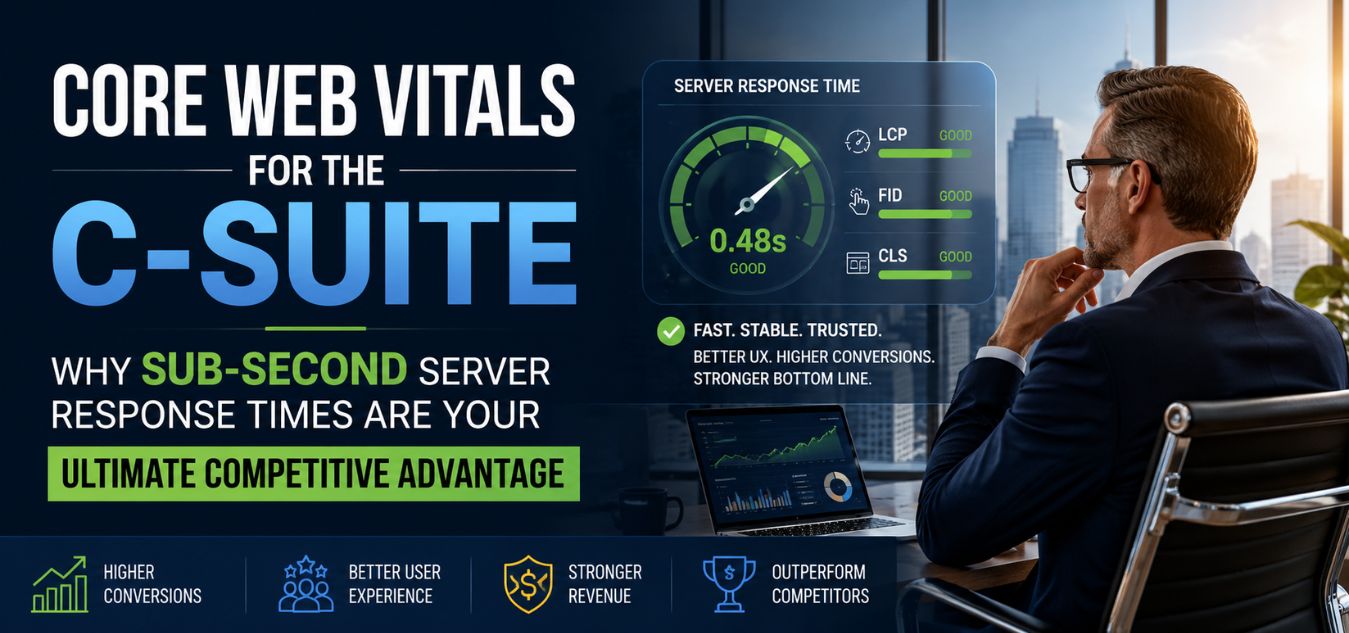
Core Web Vitals for the C-Suite: Why Sub-Second Server Response Times Are Your Ultimate Competitive Advantage
The Disconnect Between the Boardroom and the Server Room
For too long, website speed has been treated as an IT problem. C-level executives often view server response times as a highly technical metric, buried deep in quarterly engineering reports.
This is a massive strategic error. In the modern digital economy, site speed is not a vanity metric; it is a direct driver of corporate revenue.
When a digital platform takes longer than three seconds to load, enterprise bounce rates skyrocket. You are not just losing organic traffic; you are actively burning your customer acquisition budget.
💡 Executive Insight: Speed is a Business Strategy
Google’s Core Web Vitals are no longer just ranking signals. They are financial indicators. If your infrastructure cannot deliver sub-second response times, your competitors will systematically steal your market share through superior search visibility.
Today, we are translating technical SEO into boardroom strategy. We will unpack exactly why server response times represent your ultimate competitive advantage.
By the end of this guide, you will have the clear, data-backed business case needed to justify a high-performance architectural upgrade.
Core Web Vitals: The Executive Summary
Google introduced Core Web Vitals (CWV) to mathematically measure the real-world user experience of a website. Search algorithms now heavily penalize platforms that feel sluggish, unstable, or unresponsive.

To lead a digital transformation, the C-Suite must understand these three fundamental pillars. You do not need to write the code, but you must know what the code is doing to your bottom line.
Here is how technical CWV metrics translate directly into business outcomes:
| The Technical Metric | What It Actually Measures | The C-Suite Translation |
| LCP (Largest Contentful Paint) | How long it takes for the largest image or text block to fully render. | Time to Value: How fast your customer sees the product they want to buy. |
| INP (Interaction to Next Paint) | The time it takes for the site to respond to a user’s click or tap. | Operational Friction: Does the platform feel broken when the user tries to convert? |
| CLS (Cumulative Layout Shift) | How much the page layout visually jumps around as it loads. | Brand Trust: Does the site look cheap, causing the user to accidentally click the wrong button? |
When your development team asks for a budget to improve LCP or INP, they are actually asking for the resources to protect your organic search pipeline.
Why Executive Teams Can No Longer Ignore Performance Metrics
Core Web Vitals are no longer hidden engineering benchmarks buried inside developer dashboards. They are now deeply connected to:
- Customer trust and brand perception
- Search visibility and organic traffic growth
- Advertising return on investment (ROI)
- Lead generation and conversion rates
- User retention and engagement
- Mobile experience quality
- Competitive differentiation
A slow digital experience silently impacts every department inside an organization. Marketing campaigns become less efficient, sales funnels lose momentum, and customer acquisition costs rise without obvious warning signs.
This is why high-performing companies increasingly treat website speed as a strategic asset rather than a technical afterthought.
Time to First Byte (TTFB): The Ultimate Bottleneck

You can optimize your images and minify your code perfectly, but it will not matter if your server is slow. The absolute foundation of Core Web Vitals is a metric called Time to First Byte (TTFB).
TTFB measures the exact millisecond duration it takes for your user’s browser to receive the very first piece of data from your server.
If your server takes two full seconds just to “wake up” and respond, every other Core Web Vitals metric will automatically fail.
The Anatomy of a Slow Server
- 0.0s – The Click: The user clicks your link on Google.
- 0.5s – The Database Struggle: Your legacy WordPress server struggles to query a bloated MySQL database.
- 1.5s – The Code Assembly: The server slowly stitches together generic PHP templates and outdated plugins.
- 2.5s – The First Byte: The browser finally receives the first piece of data. The user has already hit the “back” button.
At Creative Riz, we constantly see enterprise platforms bleeding organic traffic simply because they are built on outdated monolithic architectures.
To achieve sub-second TTFB, you must transition to modern infrastructure. This is why our Full-Stack Development team engineers decoupled architectures using Laravel for robust backend logic and Next.js for instantaneous frontend delivery.
Why Answer Engines Demand Millisecond Responses
The landscape of organic visibility is violently shifting. We are no longer optimizing for traditional search engines; we are actively feeding AI-driven “Answer Engines.”
These automated bots crawl the internet aggressively to synthesize complex answers for users in real-time. However, they operate on ruthlessly strict “crawl budgets.”
If your legacy server takes two seconds to respond, the AI crawler will not wait for your data. It will simply abandon your platform and immediately scrape your faster competitor instead.
The SEO Debate: Speed vs. Substance
- The Contrarian View: Many traditional content marketers argue that “Information Gain” the unique, human depth of your writing is the only thing AI truly cares about, making technical server speed a secondary concern for organic rankings.
- The Engineering Reality: Content quality is completely irrelevant if the AI cannot access it efficiently. High-value content housed on a slow, monolithic server is like a brilliant book locked in a burning library. Speed is the absolute prerequisite for AI ingestion.
To secure your visibility in AI-generated summaries, you must engineer your platform for these three algorithmic realities:
- The Millisecond Mandate: AI crawlers prioritize websites that deliver structured data instantaneously. Achieving a sub-second TTFB (Time to First Byte) guarantees your content is actively ingested and cited, rather than skipped.
- Reduced Server Strain: High-performance, decoupled frameworks dynamically cache your pages at the edge. This allows aggressive AI bots to crawl your site thousands of times a day without causing an expensive server crash.
- The Citation Advantage: Answer Engines only recommend platforms they deem mathematically reliable. Blazing-fast loading speeds send an undeniable, algorithmic signal of technical authority and operational maturity.

This is especially critical for targeted, high-growth markets. If you are running campaigns in specific regions, like Pakistan, localized edge-caching and robust backend API development are completely non-negotiable for capturing regional AI search dominance.
AI Systems Prioritize Speed and Reliability
Answer engines rely on real-time content retrieval, structured data processing, and fast rendering systems. Platforms increasingly favor websites that can provide reliable information instantly because it improves the quality of the AI-generated experience.
This means performance optimization is no longer only about pleasing human visitors. It is also about ensuring AI systems can efficiently access, process, and trust your content.
Organizations that invest in sub-second server response times gain advantages such as:
| Performance Benefit | Business Impact |
|---|---|
| Faster server response | Improved user retention |
| Reduced page load time | Higher conversion potential |
| Better Core Web Vitals | Stronger search visibility |
| Faster API delivery | Improved AI indexing and retrieval |
| Stable infrastructure | Increased customer trust |
Bridging the Gap: Premium UI/UX Meets Raw Speed
A common misconception in the boardroom is that you must choose between a beautiful website and a fast website. Executives often believe that premium design inherently requires slow, heavy loading times.
This is a false dichotomy. You do not have to sacrifice your brand’s visual identity to pass a Core Web Vitals audit.
True digital excellence lies at the intersection of high-fidelity UI/UX design and ruthless technical optimization.
Here is how elite engineering teams optimize visual assets without degrading quality:
- Next-Gen Image Formats: We completely eliminate heavy JPEGs and PNGs, utilizing WebP and AVIF formats that retain flawless 4K quality at a fraction of the file size.
- Strategic Asset Loading: Above-the-fold content loads instantly, while heavy interactive elements further down the page are “lazy-loaded” only when the user scrolls to them.
- Abstract Code-Driven Art: Instead of uploading massive video files for background aesthetics, we engineer custom 2D motion graphics and animations directly using lightweight CSS and SVG code.
A premium aesthetic subconsciously validates your market authority, but it must be delivered in milliseconds to retain the user’s attention.

When infrastructure is optimized correctly, design enhancements stop feeling heavy and start feeling seamless. Pages render faster, interactions become smoother, and users stay engaged longer. More importantly, performance improvements create measurable business outcomes:
- Higher conversion rates
- Lower bounce rates
- Improved SEO visibility
- Better customer satisfaction scores
- Increased product adoption and retention
- Stronger perception of quality and reliability
The most successful digital brands understand that speed is no longer just an engineering concern. It is a business differentiator tied directly to revenue, reputation, and customer trust.
Building the ROI Case for Re-Architecture
To secure buy-in for a complete technical overhaul, you must frame the conversation around revenue, not just code. The return on investment for sub-second server response times is mathematically undeniable.
Amazon famously discovered that every 100 milliseconds of latency cost them 1% in total sales. For an enterprise B2B platform, a slow website directly translates to lost lead generation.

When you upgrade your digital infrastructure to pass Core Web Vitals, you unlock three distinct financial advantages.
| Financial Benefit | The Technical Catalyst | The Bottom-Line Impact |
| Lower Cost-Per-Acquisition | Perfect CWV scores improve your Google Quality Score for paid ads. | Cheaper ad clicks and significantly higher ad placement visibility. |
| Increased Organic Traffic | Sub-second TTFB rewards you with higher algorithmic search rankings. | Less reliance on paid media; massive influx of zero-cost, high-intent leads. |
| Higher Conversion Rates | Frictionless, instant page transitions keep the user in a “flow state.” | More forms submitted, more enterprise demos booked, and lower cart abandonment. |
Investing in a modern Next.js and Laravel tech stack is not an IT expense. It is a strategic capital allocation designed to aggressively capture market share.
Re-Architecture Is About Scalability, Not Just Speed
Many executives mistakenly associate re-architecture solely with faster page loads. In reality, the bigger advantage is scalability.
Modern architectures allow companies to:
- Handle traffic spikes without outages
- Deploy updates faster
- Support global audiences efficiently
- Integrate AI-driven systems more effectively
- Improve cybersecurity and system resilience
- Reduce long-term maintenance costs
This flexibility becomes critical as businesses expand into new markets, launch digital products, or adopt advanced technologies.
Without modernization, organizations often reach a point where every new feature slows development further. Innovation becomes difficult because the existing infrastructure cannot support growth efficiently.
Final Thoughts: Speed as a Core Value
As an executive, you cannot afford to delegate the responsibility of site performance entirely to the development team. Core Web Vitals must be tracked as closely as your quarterly sales targets.
Sub-second server response times represent a deep operational respect for your user’s time. When your platform loads instantly, it projects absolute competence and authority.
If your current digital presence feels sluggish, your competitors are already siphoning your high-ticket leads.
Do not let outdated infrastructure dictate your market ceiling. Demand a Core Web Vitals audit from your technical team this week.
Frequently Asked Questions (FAQs)
1. What is the difference between TTFB and LCP?
Time to First Byte (TTFB) measures how fast your server reacts to a request. Largest Contentful Paint (LCP) measures how fast the browser renders the visual content on the screen after the server responds. Think of TTFB as the foundation of a house, and LCP as the visible structure built on top of it. You cannot have a fast LCP without a blazing-fast TTFB.
2. Why did Google replace FID with INP in the Core Web Vitals update?
First Input Delay (FID) only measured the delay of the very first click a user made on a page, which was often an incomplete picture of performance. Interaction to Next Paint (INP) is a much stricter, more comprehensive metric. It measures the latency of every single click, tap, and keyboard interaction throughout the user’s entire lifespan on that specific page, ensuring a consistently smooth experience.
3. How can our executive team easily check our current Core Web Vitals scores?
You do not need access to complex developer tools. You can run any URL through Google’s free PageSpeed Insights tool. It will provide a straightforward “Pass” or “Fail” grade for Core Web Vitals based on real-world Chrome user data over the last 28 days, giving your board an immediate, objective look at your technical SEO health.
1. What is the difference between TTFB and LCP?
Time to First Byte (TTFB) measures how fast your server reacts to a request. Largest Contentful Paint (LCP) measures how fast the browser renders the visual content on the screen after the server responds. Think of TTFB as the foundation of a house, and LCP as the visible structure built on top of it. You cannot have a fast LCP without a blazing-fast TTFB.
2. Why did Google replace FID with INP in the Core Web Vitals update?
First Input Delay (FID) only measured the delay of the very first click a user made on a page, which was often an incomplete picture of performance. Interaction to Next Paint (INP) is a much stricter, more comprehensive metric. It measures the latency of every single click, tap, and keyboard interaction throughout the user’s entire lifespan on that specific page, ensuring a consistently smooth experience.
3. How can our executive team easily check our current Core Web Vitals scores?
You do not need access to complex developer tools. You can run any URL through Google’s free PageSpeed Insights tool. It will provide a straightforward “Pass” or “Fail” grade for Core Web Vitals based on real-world Chrome user data over the last 28 days, giving your board an immediate, objective look at your technical SEO health.
About the Author