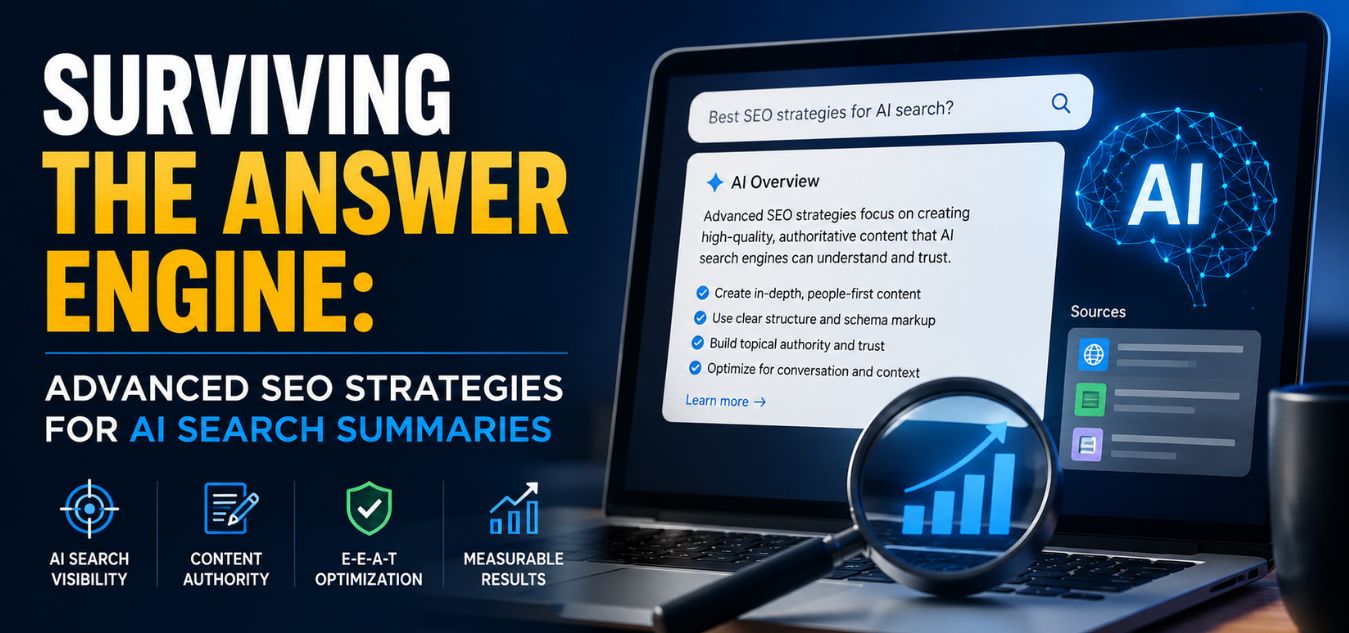
Surviving the Answer Engine: Advanced SEO Strategies for AI Search Summaries
The Death of the “Ten Blue Links”
The traditional search engine is undergoing a massive, irreversible evolution. We are officially transitioning from the era of “Search Engines” to the era of “Answer Engines.”
When modern users ask a complex question, they no longer want to hunt through ten blue links to piece together an answer. They expect an AI-generated summary to immediately synthesize the best information at the top of the page.
For enterprise brands and service providers, this shift is triggering widespread panic. If an AI summary answers the user’s question directly on the search results page, why would they ever click through to your website?
💡 Expert Insight: The Zero-Click Reality
Zero-click searches are becoming the industry standard. Your new SEO objective is not just to drive traffic, but to become the authoritative source data that the AI cites in its overarching summary.
Today, we are unpacking how to survive and thrive in the Answer Engine era. We will explore advanced SEO strategies designed to secure your visibility when AI models generate search summaries.
By the end of this guide, you will understand how to structure your brand’s digital presence to feed AI crawlers while actively capturing high-ticket B2B leads.
Understanding the Shift: Search vs. Answer
To optimize for the future, you must understand how the underlying technology has fundamentally changed. Traditional search engines used algorithms to rank documents based on keyword density and backlink profiles.

Modern Answer Engines utilize Large Language Models (LLMs) to actually read, comprehend, and summarize those documents in real-time.
They do not just match keywords; they evaluate context, entity relationships, and genuine expertise. If your content is generic or overly robotic, the AI will completely ignore it in favor of a more authoritative source.
Here is exactly how the digital landscape has shifted:
| SEO Element | Traditional Search Engine | Modern Answer Engine (AI) |
| User Goal | Find a list of relevant websites to browse. | Get an immediate, synthesized answer without clicking. |
| Content Strategy | Keyword stuffing and matching search volume. | Semantic depth, answering natural language questions perfectly. |
| The “Win” State | Ranking #1 in the organic blue links. | Being cited as the primary source in the AI Overview block. |
| Evaluation Metric | Backlinks and exact-match anchor text. | E-E-A-T (Experience, Expertise, Authoritativeness, Trustworthiness). |
Experience and Expertise: Defeating Generic AI
Here is a harsh reality: you cannot out-write an AI using generic information. If your company blog simply rewrites the same basic definitions as your competitors, an Answer Engine will never cite you.
Today’s search algorithms are desperately looking for “Information Gain.” To secure visibility, you must heavily lean into Google’s E-E-A-T framework (Experience, Expertise, Authoritativeness, and Trustworthiness). You have to prove that there are highly competent, experienced humans behind your corporate brand providing unique data and firsthand insights that simply do not exist anywhere else on the web.
“Why is our organic traffic tanking?” Sarah, the VP of Marketing, stared at the analytics dashboard in frustration. “We published thirty articles last month. We’re doing everything right.”
“But what did we actually publish?” replied Mark, the lead engineer. He pulled up their latest post on his monitor. “Look at this: ‘What is Cloud Security?’ Sarah, an AI can write this exact article in four seconds. Why would an Answer Engine ever use us as a source?”
Sarah frowned. “So what do we do? We can’t produce content faster than a machine.”
“We don’t write faster,” Mark said, leaning forward. “We write deeper. We stop defining terms and start writing the exact step-by-step process of how we secured that Fintech client’s server last week. We share the code, the bottlenecks, and the metrics. AI doesn’t have clients or real-world friction. We do.”

To survive the Answer Engine evolution, you must completely pivot your content strategy from mass production to high-value expertise. Here is how to structure your content to guarantee Information Gain:
- Highlight Real-World Experience: Do not just explain what a strategy is; explain how you successfully implemented it. Share specific performance metrics, expose unexpected client bottlenecks, and detail the precise, actionable steps your team took to solve them.
- Showcase Technical Authority: Move beyond surface-level advice. If you are a development agency, stop writing generic posts about “Why you need a website.” Instead, publish a deeply technical breakdown on optimizing Next.js architectures for sub-second load times.
- Enforce Author Transparency: Ensure every piece of content is anchored to a real, verifiable human. Tie your articles to an author with an established industry footprint, complete with a detailed bio, field credentials, and links to their professional profiles.
To fully understand the shift required to secure visibility, look at the stark difference between producing generic text and engineering expert content:
| Content Metric | Generic Content (The AI Default) | Expert Content (The Human Advantage) |
| The Core Strategy | Rewriting basic definitions and widely known facts. | Sharing original research, proprietary data, and client case studies. |
| The Depth | Explaining what a concept is to a beginner. | Explaining how to execute it in a complex, real-world scenario. |
| The Authorship | Anonymous, ghostwritten, or published under a generic brand name. | Authored by a verified, credentialed industry professional. |
| The SEO Result | Ignored by AI summaries and pushed down in search rankings. | Cited directly by Answer Engines as a primary, authoritative source. |
Structuring Data for the AI Crawler
You can publish the most brilliant, industry-defining insights, but if they are buried deep within massive, unbroken blocks of text, AI models will simply skip over them. Modern LLMs are incredibly smart, but they are technically lazy; they gravitate toward information that is mathematically structured and effortless to parse.

To solve this, you must stop writing traditional articles and start architecting data. By enforcing strict, technical on-page formatting, you feed the machine exactly what it wants, transforming your website into a highly organized database that Answer Engines eagerly and consistently cite.
To understand how this formatting directly solves crawler bottlenecks, look at this Pain-Fix-Outcome breakdown:
| The Crawler Bottleneck (Pain) | The Technical Formatting (Fix) | The AI Ranking Result (Outcome) |
| Rambling Introductions: The AI cannot quickly identify the main point of the page. | The Direct Answer Hook: A bold, 2-to-3 sentence summary at the very top of the page. | The AI easily captures the exact quote to use as the primary search summary. |
| Dense Text Walls: Complex workflows written in long paragraphs cause crawler fatigue. | Structured Data Sets: Converting heavy paragraphs into bullet points and HTML tables. | Effortless parsing. LLMs inherently prefer to read and display data in tables. |
| Chaotic Outlines: Randomly sized text looks like unstructured noise to a bot. | Semantic HTML Hierarchy: Using strict <H2> and <H3> tags to form a logical outline. | Creates an invisible, perfect roadmap for the crawler to index your expertise. |
| Isolated Content: Standalone articles lack the connected context an AI needs to trust it. | Internal Entity Linking: Connecting concepts via descriptive, natural anchor text. | Weaves a dense web of relevance, proving your overarching topical authority. |
When you implement this architecture, you must meticulously audit how your text is presented on the screen.
- Master the Hook: Never make the AI guess your conclusion. Begin every major section by directly answering the target question before diving into the nuances.
- Embrace the Grid: Whenever you find yourself comparing two concepts with commas and conjunctions, stop. Rewrite that sentence into a clean, two-column HTML table.
- Enforce Code Hygiene: Work closely with your developers to ensure your visual headings are actually mapped to proper Semantic HTML5 tags in the backend.
- Connect the Nodes: Treat your website like a neural network. Link your deeply technical blog posts directly to your core service pages to signal your comprehensive mastery of the topic.
Speed and Architecture: The Answer Engine Prerequisite
An Answer Engine is built on a single, uncompromising metric: speed. It needs to synthesize and deliver results to the user in a matter of milliseconds.
If your website takes four seconds to load, the AI crawler will not wait. It will abandon your page entirely and pull data from a faster, even if less knowledgeable, competitor.
In the era of AI summaries, elite technical performance is no longer a luxury; it is the absolute baseline prerequisite for visibility. Your backend architecture directly dictates your SEO success, making bloated legacy code and heavy templates active liabilities.

Scenario Roleplay: The “Invisible” Content
David (Founder): “Elena, we published that 3,000-word Zero-Trust API guide last month. It’s the best technical resource on the market. Why is the AI summary citing our competitor’s generic post instead of us?”
Elena (Lead Engineer): “I looked at the server logs, David. The crawler tried to read our guide. But our legacy theme loaded 40 megabytes of unoptimized scripts before rendering the text. The page took 4.2 seconds to load.”
David: “So? The content is still better.”
Elena: “So, the AI crawler timed out at 2 seconds. To the Answer Engine, our masterpiece literally doesn’t exist. Our competitor’s site is built on a modern framework and loads in 0.4 seconds. They won the citation on speed alone.”
To ensure your platform survives the crawler timeout window, you must eradicate technical bloat. Here is how we engineer architecture that Answer Engines instantly process and prioritize:
- Decoupled Architectures: We heavily utilize modern frameworks like Next.js for frontend delivery. This allows pages to be pre-rendered and served almost instantly to both users and AI crawlers.
- Immaculate Code Hygiene: Search crawlers should not have to dig through thousands of lines of messy JavaScript just to find your core text. Clean, minimalist code ensures rapid indexing.
- Microscopic Asset Delivery: Heavy images kill crawl budgets. We employ next-generation formats (WebP) and JSON-based Lottie animations to keep pages visually stunning but mathematically weightless.
When Design Becomes Data: The Role of UI/UX

In a world dominated by zero-click AI summaries, the organic clicks you do earn are incredibly valuable. When a user bypasses the AI and clicks your link, they are not looking for a basic answer; they are demanding a premium, deep-dive experience.
If they land on a cluttered, outdated page, they will bounce instantly. Answer Engines actively track this user behavior specifically dwell time and bounce rate to mathematically judge if your site is genuinely helpful.
Because of this, your visual brand identity is now a critical SEO ranking factor. A premium aesthetic subconsciously validates the technical expertise written on the page.
Here is how to engineer your UI/UX to send positive data signals directly to the Answer Engine:
- The Minimalist Corporate Standard: We consistently utilize a high-contrast, minimalist aesthetic often leveraging deep purples, crisp whites, and generous negative space. This immediately signals operational maturity and eliminates cognitive friction.
- Rapid-Fire Stat: Interfaces burdened with heavy visual clutter suffer up to a 50% higher bounce rate, actively signaling to AI crawlers that the page is unhelpful.
- Custom Visual Assets: Stop using generic stock photos immediately. AI algorithms easily identify duplicate images across the web, instantly flagging your content as unoriginal. Invest in custom, abstract 2D motion graphics and bespoke infographics.
- Rapid-Fire Stat: Original data visualizations and custom graphics keep B2B users on-page 2.5x longer than repetitive, standard stock photography.
- Frictionless Navigation: The user must be able to find exactly what they need within a maximum of two clicks. Intuitive, frictionless navigation prevents prospect frustration and drastically increases your average session duration.
- Rapid-Fire Stat: Increasing an enterprise user’s dwell time by just 30 seconds sends massive positive trust signals back to the Answer Engine, securing long-term visibility.
Mini Case Snapshots: Winning the AI Citation
Theoretical strategy only goes so far. To truly understand how to secure visibility in AI-generated summaries, we must look at how these tactics play out in real-world B2B scenarios.
Here is how optimizing for the Answer Engine directly influences corporate revenue:
Mini Case Snapshot: The SaaS Knowledge Base
- The Bottleneck: A B2B software company saw organic traffic plummet as AI Overviews began directly answering user questions about their specific industry software.
- The Answer Engine Fix: We restructured their massive, text-heavy support articles into clean, bulleted step-by-step guides and integrated highly structured HTML tables comparing their software to legacy solutions.
- The ROI: Within two months, the software company became the primary cited source link within the AI search summaries, driving highly qualified, high-intent enterprise leads directly to their booking page.
Mini Case Snapshot: The Technical Consultancy
- The Bottleneck: An IT consultancy was publishing generic, 500-word blog posts about “Cloud Security” that were completely ignored by both Google and modern LLMs.
- The Answer Engine Fix: We shifted their strategy to deeply technical, 2,000-word case studies. We injected firsthand accounts of implementing Zero-Trust HMAC architectures for their clients, providing entirely unique data to the market.
- The ROI: By satisfying the E-E-A-T mandate with genuine experience, their articles began ranking above massive tech publishers, cementing their reputation as an elite technical authority.
Final Thoughts: Embrace the Evolution
The era of tricking algorithms with keyword density and purchased backlinks is permanently over. Answer Engines are too intelligent to be manipulated by outdated SEO tactics.
To survive and dominate in this new landscape, corporate brands must pivot their focus entirely toward the user. You must become the absolute best, most experienced, and most technologically sound answer on the internet.
By combining deep, firsthand expertise with lightning-fast Next.js architecture and premium UI/UX design, you build a digital fortress that AI crawlers inherently trust and cite.
Do not fear the Answer Engine. If you are a genuine expert in your field, this technological shift is the greatest opportunity you have ever had to outrank your competitors.
Frequently Asked Questions (FAQs)
1. Will AI search summaries completely eliminate organic website traffic?
No, they will not eliminate it, but they will refine it. AI summaries will satisfy low-intent, informational queries (like “What does API stand for?”). However, for complex, high-stakes B2B queries, users will always click through to the cited source to verify the information and explore deep-dive case studies. The traffic you receive will be lower in volume, but significantly higher in purchasing intent.
2. How long does it take to see SEO results when optimizing for Answer Engines?
Because LLMs update their indexes and training models continuously, highly structured, E-E-A-T optimized content can be picked up and cited in AI summaries faster than traditional Google rankings. However, building the underlying domain authority and technical speed required to be trusted by the AI still requires a sustained, 3-to-6 month strategic commitment.
3. Does our brand’s color palette and visual design actually affect our SEO?
Indirectly, yes. While a search crawler cannot “see” a color, it tracks how human users react to your design. If your website uses a chaotic layout and hard-to-read text, users will experience cognitive overload and immediately bounce back to the search results. This rapid bouncing signals to the Answer Engine that your site is unhelpful, which will actively destroy your rankings. Premium design ensures high dwell time, which secures your SEO positioning.
About the Author