Beyond the Landing Page: AI Personalization in Conversion Design
The Death of the One-Size-Fits-All Landing Page
For years, digital marketing relied on building beautiful, static landing pages and hoping the target audience converts. Today, that “one-size-fits-all” approach is rapidly losing its effectiveness as users expect digital experiences to understand their specific needs instantly. If your landing page shows the exact same content to a seasoned CEO and a college student, you are leaving money on the table.
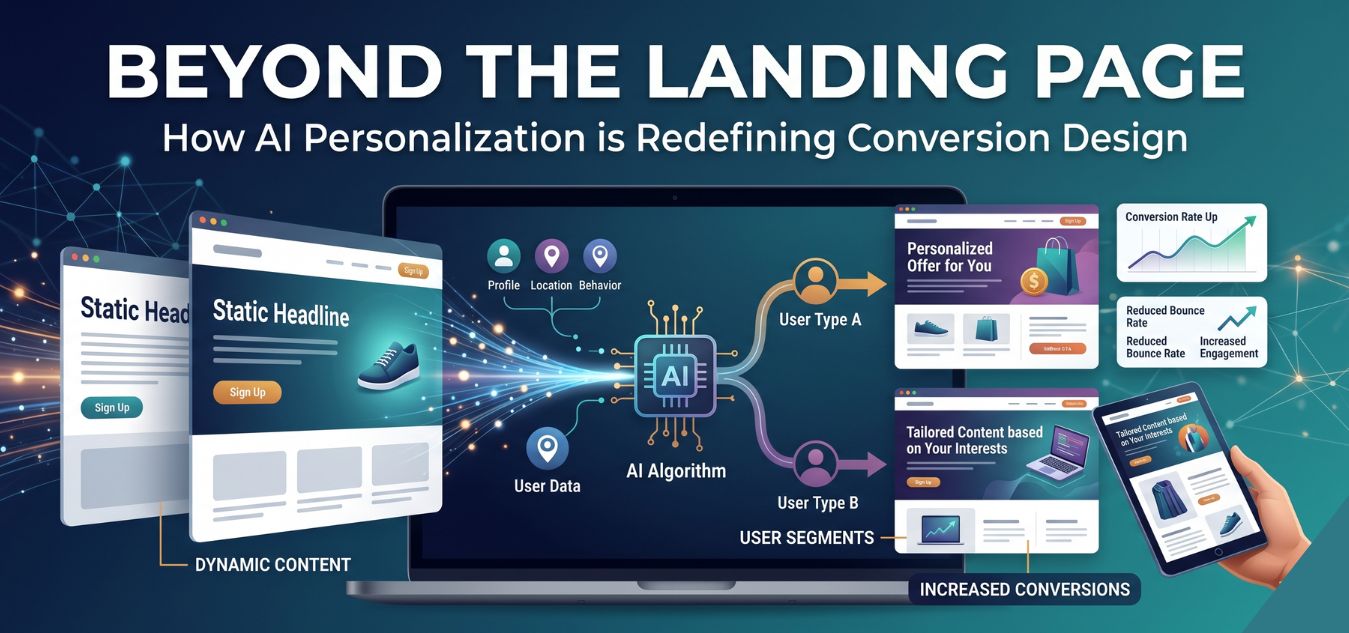
- The Adaptive Shift: AI personalization is completely redefining conversion design by shifting the focus from building one static page to creating a fluid, adaptive experience.
- Design That Converts: At Creative Riz, we specialize in bridging the gap between stunning visual design and data-driven marketing to ensure your interfaces actually drive revenue.
- Expert Implementation: As we explore how AI is moving us beyond static pages below, remember you can always upgrade your platform with our Custom UI/UX Design Services.
What is AI-Driven Conversion Design?
Traditional conversion rate optimization (CRO) relies heavily on human guesswork. Marketers manually change a button color or a headline and wait weeks for data.
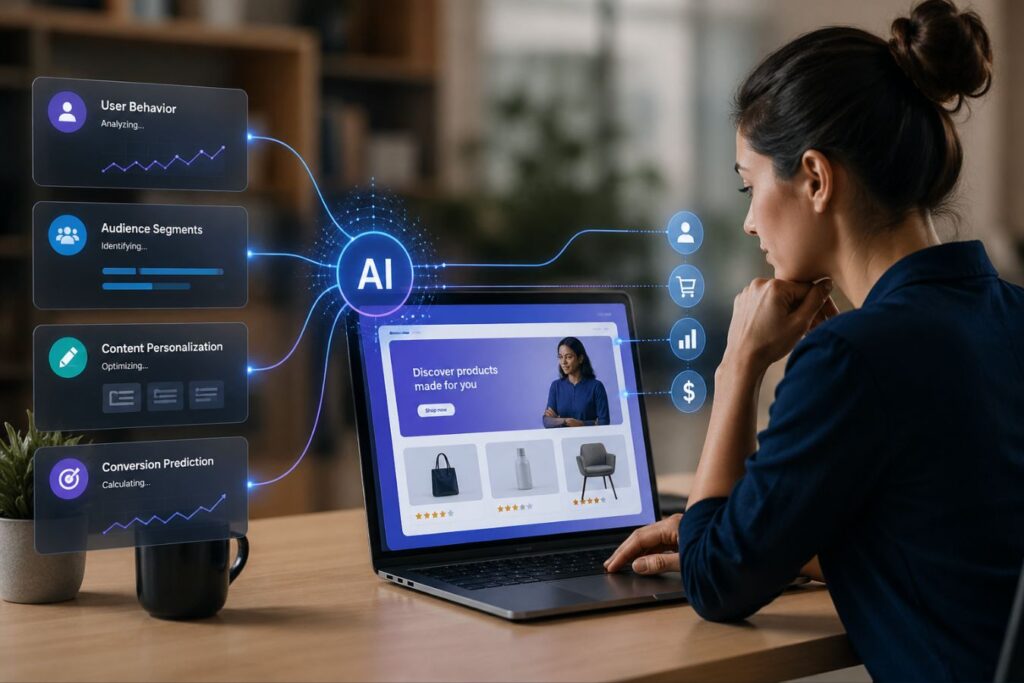
AI-driven conversion design flips this process upside down. It uses machine learning algorithms to adjust the UI and UX in real time based on user behavior.
The page essentially redesigns itself to match the psychological profile of the person viewing it.
How AI Adapts the Interface:
- Dynamic Typography: Adjusting font sizes and reading complexity based on the user’s browsing history.
- Adaptive Imagery: Swapping out hero images to reflect the user’s local weather, time of day, or demographic.
- Fluid Layouts: Moving high-priority content blocks higher up the page if the user is known to skim quickly.
This is not just marketing automation; it is a fundamental shift in product design.
Check out our Marketing Design Portfolio to see adaptive layouts in action.
The Problem with Traditional A/B Testing
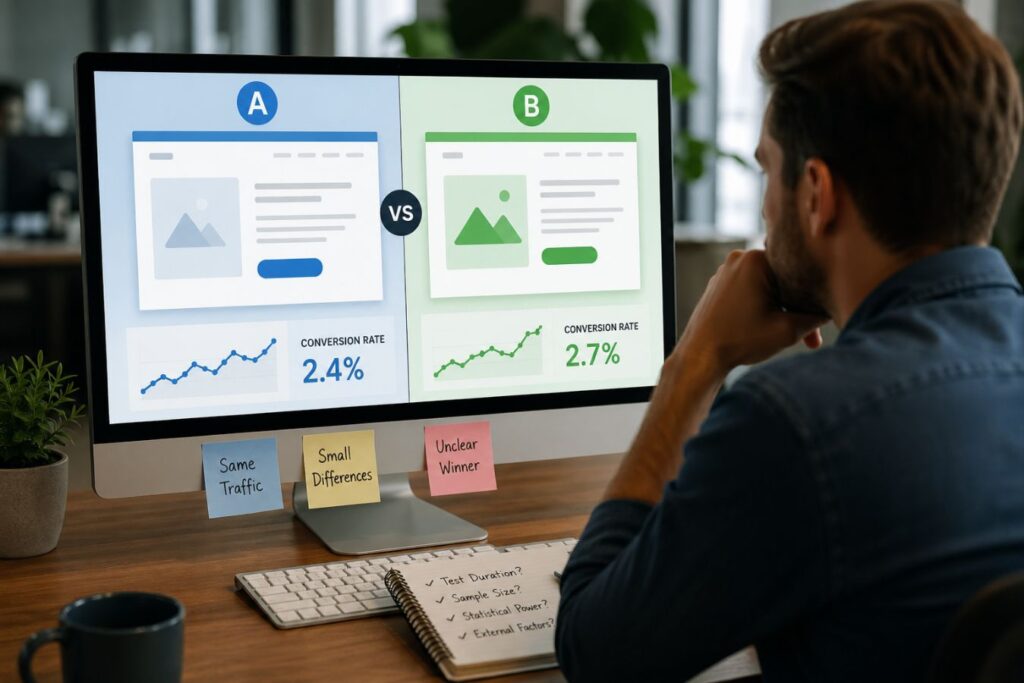
A/B testing has been the gold standard for marketing design for over a decade. You test Design A against Design B and pick the winner.
But A/B testing has a massive flaw: it only tells you what works best for the average user. It ignores the nuances of individual preferences.
If Design A wins by 60%, you are still providing a sub-optimal experience to the 40% who preferred Design B.
Why AI Personalization Beats A/B Testing:
- Micro-Targeting: AI does not look for an average winner; it delivers Design A to group A, and Design B to group B simultaneously.
- Speed to Market: You do not have to wait a month for statistical significance. The AI optimizes traffic routing in milliseconds.
- Continuous Learning: The algorithm never stops testing. It constantly introduces slight variations to find entirely new conversion pathways.
Core Elements of Personalized Conversion Design
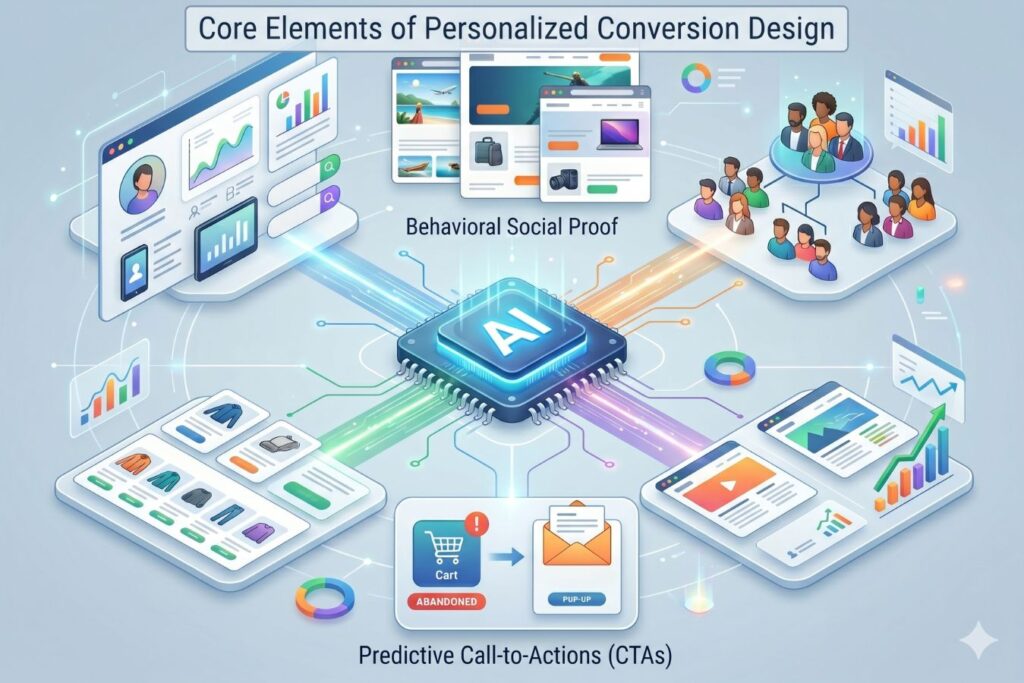
Implementing AI into your marketing design requires a modular approach. You cannot design a page as a single, flattened image file.
Instead, you must design a system of interchangeable components. The AI then acts as the art director, assembling these pieces on the fly.
Here are the core elements you need to build a personalized conversion engine.
1. Contextual Hero Sections
The hero section is your first impression. AI can swap the headline and background video to match the specific search term the user typed into Google.
2. Behavioral Social Proof
Showing generic testimonials is no longer enough. AI can display reviews from customers in the user’s specific industry or geographic region.
3. Predictive Call-to-Actions (CTAs)
Some users are ready to “Buy Now,” while others need to “Read the Case Study.” AI predicts the user’s intent level and changes the CTA button accordingly.
This component-based design strategy is at the heart of everything we do. Learn more about our modular approach on our Branding & Strategy Page.
Integrating Personalization with High-Performance Tech Stacks
Beautiful, personalized design is useless if it takes ten seconds to load. Speed is a critical factor in both web security and conversion rates.
To render personalized UI components in real time without lag, you need a robust technical foundation.
You cannot rely on bloated, legacy website builders to handle complex AI logic effectively.
The Ideal Tech Stack for AI Personalization:
- Frontend (Next.js): Essential for server-side rendering and lightning-fast dynamic content delivery.
- Backend (Laravel): Provides a secure, highly scalable API infrastructure to process user data and AI logic smoothly.
- Middleware: Acts as the traffic cop, instantly checking user consent and securely fetching personalized assets.
When your marketing campaigns such as high-reach Facebook and Instagram ads drive traffic, the landing page must react instantly. We specialize in building these exact high-speed environments.
Static Pages vs. AI-Personalized Pages
To visualize the impact of this shift, let’s compare a traditional landing page with a modern, AI-driven conversion page.
This side-by-side breakdown highlights why static design is losing its competitive edge.
| Feature | Static Landing Page | AI-Personalized Page |
| User Experience | Identical for every visitor | Unique to each visitor’s context |
| Content Strategy | Broad messaging hoping to catch everyone | Hyper-specific messaging matching user intent |
| Optimization Method | Manual A/B testing over weeks | Real-time multivariate testing in milliseconds |
| Image Relevance | Generic stock photos or static product shots | Dynamic images reflecting location or industry |
| Conversion Rate | Industry average (typically 2-4%) | Often yields double-digit conversion rates |
Upgrading from a static site to an AI-driven platform immediately elevates your brand’s authority.
Infographic Concept: The Real-Time Conversion Loop
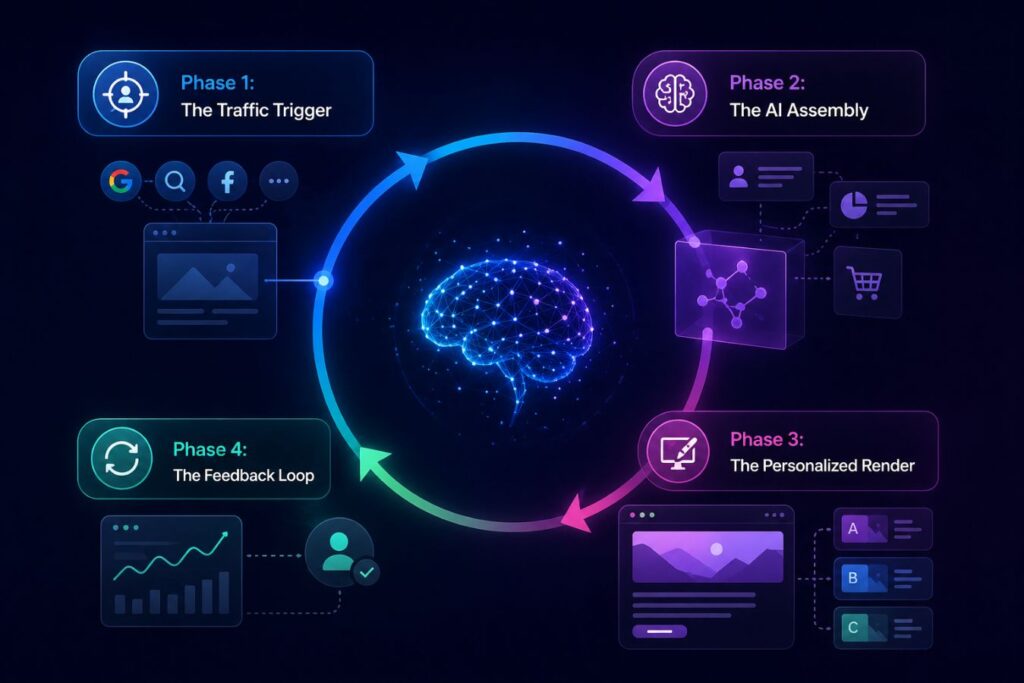
To help your team visualize how AI personalization works on a technical and visual level, here is a breakdown of the “Real-Time Conversion Loop.”
Phase 1: The Traffic Trigger
- Action: A user clicks your awareness ad on Instagram.
- Data Captured: Time of day, device type, geographic location, and the specific ad creative they clicked.
Phase 2: The AI Assembly
- Action: The middleware processes the data in milliseconds.
- Design Shift: The server selects the UI components that historically perform best for that specific demographic.
Phase 3: The Personalized Render
- Action: The Next.js frontend delivers the customized page instantly.
- Visual Result: The user sees a localized hero image, targeted copy, and a highly relevant CTA.
Phase 4: The Feedback Loop
- Action: The user’s interaction (scroll depth, click, or bounce) is fed back into the AI.
- Outcome: The algorithm gets smarter for the next visitor.
Localized Personalization: Winning Emerging Markets
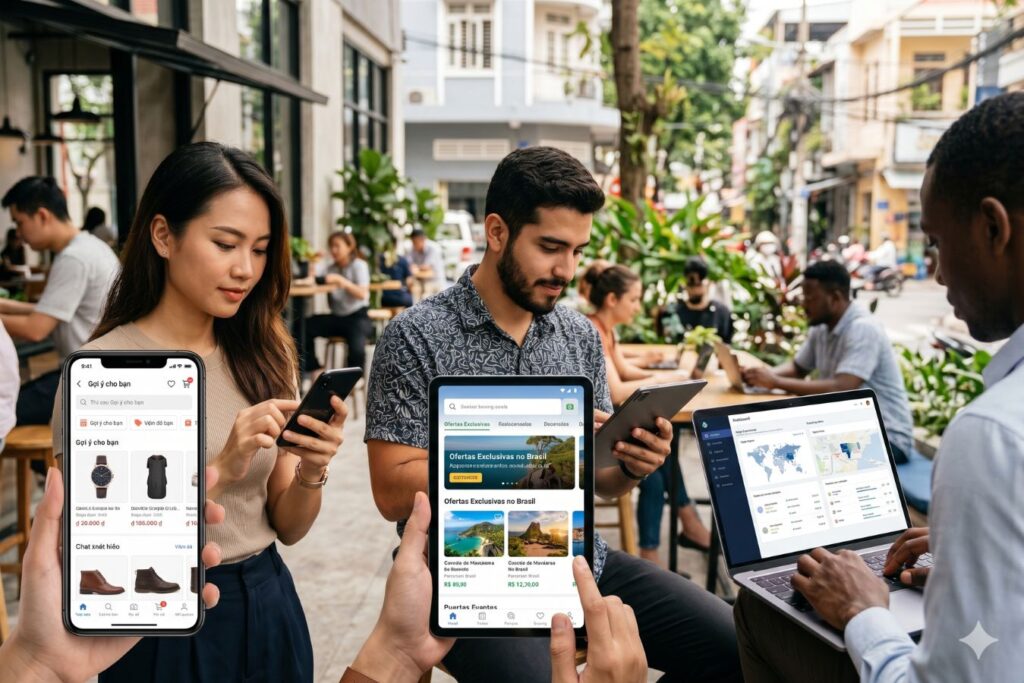
Personalization is incredibly powerful when targeting specific geographic markets. Consumer behavior varies wildly from one region to another.
For example, when running digital marketing campaigns targeted strictly at the Pakistan market, cultural context is everything.
A static page designed for a Western audience will often fall flat when presented to South Asian consumers.
How AI Localizes Design:
- Cultural Imagery: Automatically displaying lifestyle images that resonate with local customs and aesthetics.
- Language Nuances: Adjusting the copy to use region-specific terminology or localized pricing structures.
- Trust Signals: Highlighting local payment gateways or regional security certifications dynamically.
By localizing the digital experience, you build immediate trust. If you are launching campaigns in new territories.
Balancing Personalization with User Privacy (Ethical UX)

We cannot discuss AI data tracking without addressing web security and user privacy.
Modern consumers are highly protective of their personal information. If your personalization feels invasive or “creepy,” it will destroy your conversion rate.
Ethical UX must be the foundation of your AI marketing strategy. You must build trust before you leverage user data.
Principles of Ethical AI Personalization:
- Explicit Consent: Never track behavioral data without clear, jargon-free consent banners.
- Data Minimization: Only collect the data absolutely necessary to improve the immediate user experience.
- Transparent UI: If a page is customized based on user history, subtle micro-copy (e.g., “Recommended for you”) helps explain why.
Good design respects the user. When you prioritize ethical UX, personalization feels like a premium concierge service, not surveillance.
Overcoming the “Content Bottleneck”
The biggest challenge in AI conversion design isn’t the technology; it is the content creation.
If your AI needs to show 50 different variations of a landing page, your design team has to create 50 different assets.
This is where generative AI tools become an essential part of the design workflow.
Scaling Creative Output:
- AI Copywriting: Using secure LLMs to generate dozens of headline variations based on your core brand voice.
- Generative Imagery: Creating background variations and asset resizing instantly to fit adaptive UI components.
- Automated Layouts: Letting the AI dictate spacing and typography scaling for different mobile devices.
Case Studies in Motion: How We Apply This
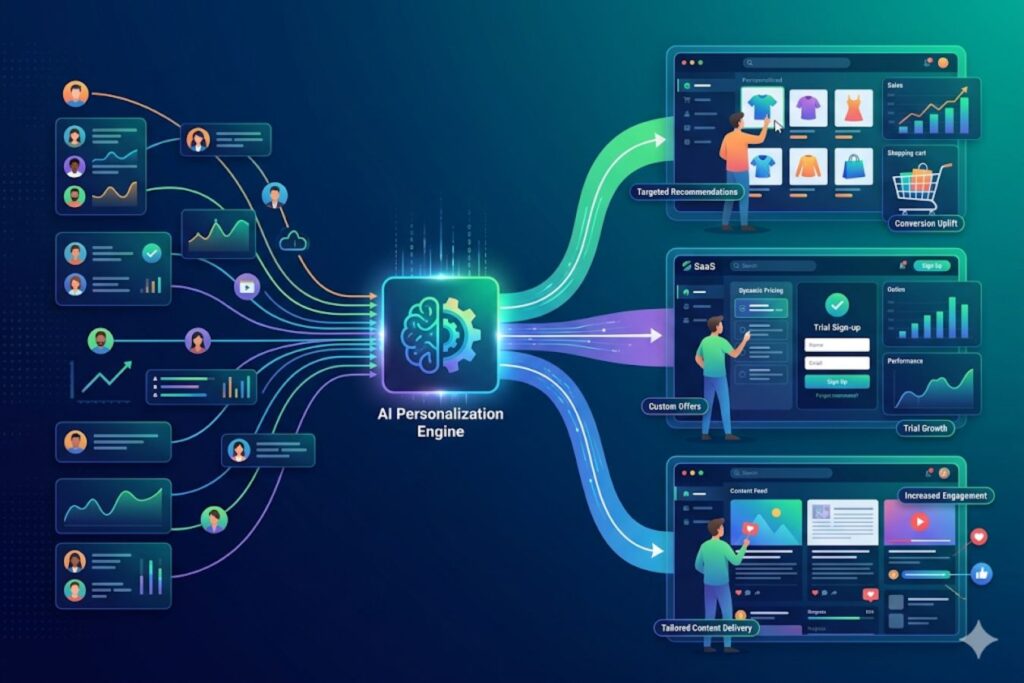
Theory is great, but results matter. Integrating AI into marketing design has transformed how we deliver ROI for our clients.
We don’t just build websites; we build dynamic growth engines designed to capture attention and drive revenue.
Here are a few ways we apply these frameworks in the real world.
Real-World Applications:
- B2B SaaS: We use dynamic intent-scoring to change the CTA from “Start Free Trial” to “Talk to Sales” for high-value enterprise visitors.
- E-commerce: We implement predictive product grids that rearrange themselves based on the user’s previous browsing history.
- Service Agencies: We dynamically alter the portfolio items shown on the homepage to match the industry of the incoming web traffic.
The Future: Predictive Conversion Architecture
We are moving away from reactive design and entering the era of predictive conversion architecture.
Soon, AI will not just rearrange pre-made components; it will generate entirely new UI elements on the fly.
The interface will mold itself to the user like a digital glove.
Brands that embrace this technology now will establish an insurmountable competitive advantage. Those who stick to static landing pages will fade into obscurity.
The future of marketing design is dynamic, intelligent, and highly personalized.
Are you ready to transform your digital presence? Reach out to Creative Riz today, and let’s build an adaptive experience that scales. Contact Our Design Team.
Frequently Asked Questions (FAQs)
Does AI personalization slow down my website’s loading speed?
If implemented correctly using modern frameworks like Next.js, AI personalization does not slow down your site. The dynamic rendering happens server-side in milliseconds, ensuring the user receives a fully optimized, lightning-fast experience without relying on heavy client-side scripts.
Is AI conversion design only for large enterprise companies?
Not anymore. While it used to require massive budgets, the rise of accessible AI tools and headless CMS platforms has made dynamic personalization affordable for startups and mid-sized agencies. You can start small by simply personalizing your hero headlines and scale up from there.
How do we prevent our personalized pages from feeling invasive to users?
The key is “Ethical UX.” Always ask for explicit cookie consent, prioritize data security, and ensure the personalization adds genuine value. If the dynamic content helps the user find what they are looking for faster, it feels like excellent customer service rather than an invasion of privacy.
About the Author